
Graphical Abstract
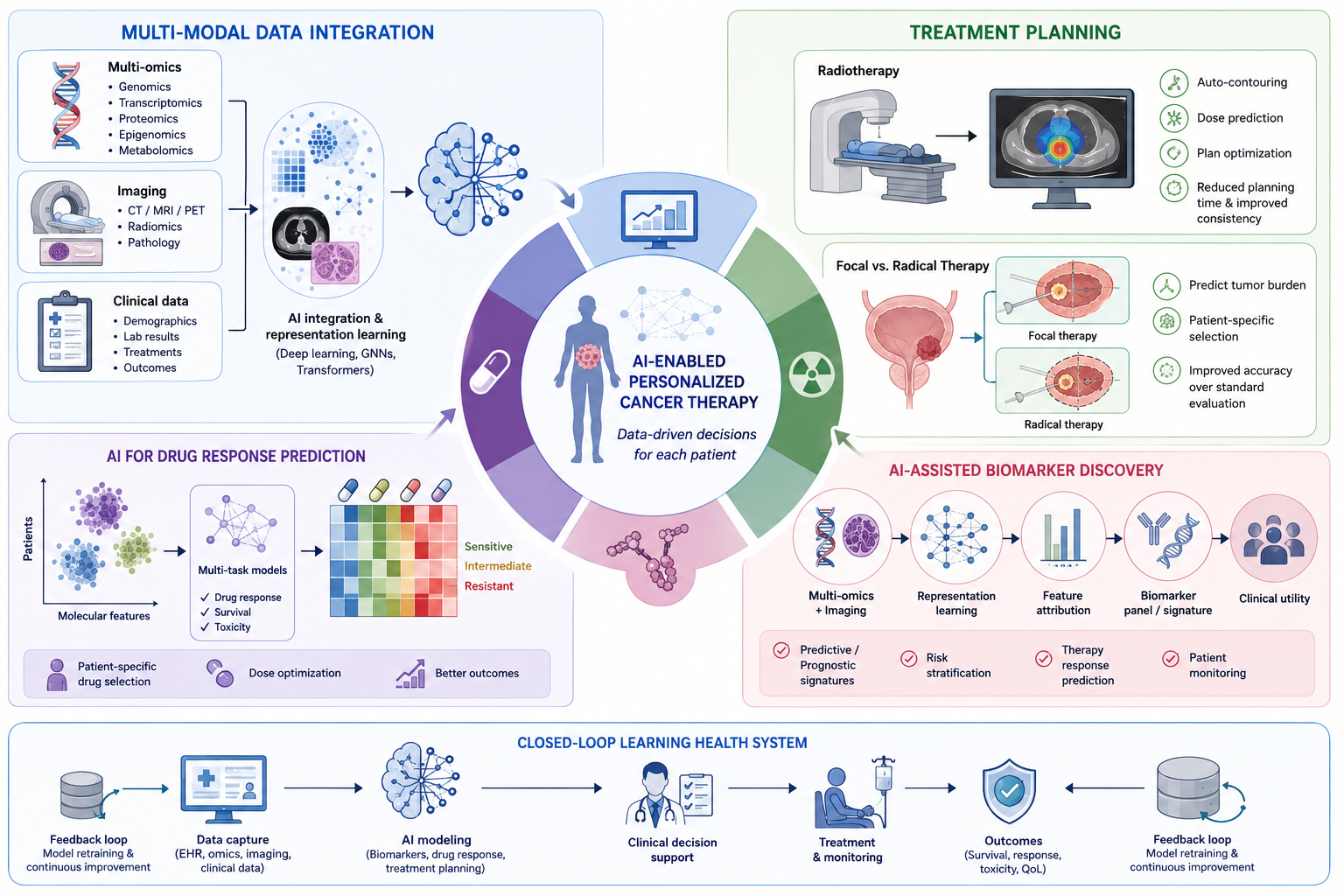
Graphical Abstract: Artificial Intelligence in Personalized Cancer Therapy and Biomarker Discovery
INTRODUCTION
Cancer therapy has undergone a fundamental shift, moving away from generalized treatment protocols toward precision oncology an approach that tailors therapy to each patient's molecular, imaging, and clinical profile 1. High-throughput molecular assays spanning genomics, transcriptomics, and proteomics, combined with advanced imaging modalities and large-scale clinical databases, have generated vast quantities of high-dimensional data 2. However, the sheer complexity and diversity of these data sources exceed the capacity of conventional statistical methods and clinical judgment alone to yield reliable predictions of drug response, optimal treatment design, or robust biomarker identification 3. Personalized cancer therapy aims to identify the most appropriate drug, dose, and treatment strategy for each patient based on the unique biology of their tumor and individual clinical characteristics 4. The rapid expansion of data from genomics, transcriptomics, proteomics, metabolomics, radiomics, and real-world clinical records presents considerable analytical challenges 5. Extracting clinically meaningful insights from such heterogeneous and high-dimensional data requires computational approaches that go beyond traditional analytical frameworks.
Artificial intelligence, encompassing machine learning (ML) and deep learning (DL), has emerged as a promising set of tools to address these challenges. These methods enable the extraction of complex patterns from large datasets, the integration of multiple data types, and the generation of actionable predictions 6,7,8,6,7,8,6,7,8.
Importantly, AI applications in oncology have expanded beyond diagnosis to encompass treatment planning, drug response prediction, and biomarker discovery, representing a meaningful evolution in how cancer care is conceptualized and delivered 9,10,9,10. While prior reviews have addressed specific aspects of AI in oncology such as imaging analysis, radiotherapy planning, or genomic modeling most have done so in isolation. Few have attempted to synthesize developments across drug response prediction, treatment planning, and biomarker discovery within a unified framework. Moreover, key concerns regarding data quality, model interpretability, and clinical generalizability remain insufficiently consolidated in the existing literature.
This integrative review addresses that gap by synthesizing advances published between 2020 and 2025 across three interconnected domains. Specifically, it aims to: (i) summarize recent developments in AI-driven drug response prediction;(ii) outline the role of AI in treatment planning, with particular focus on radiotherapy and focal versus radical therapy decisions; (iii) review AI-assisted biomarker discovery through multi-omics integration; and (iv) present a conceptual framework that unifies these areas into a coherent model for AI-enabled personalized oncology.
CONCEPTUAL FRAMEWORK: AI-ENABLED PERSONALIZED CANCER THERAPY
The integration of AI into oncology is increasingly being pursued through unified, end-to-end workflows that connect data collection to clinical decision-making 9. These workflows draw on three broad categories of input data: biological data encompassing genomic variants, transcriptomes, epigenomes, proteomes, and metabolomes; imaging data including CT, MRI, PET scans, histopathology slides, and radiomics features; and clinical data comprising patient demographics, laboratory results, comorbidities, treatment history, and recorded outcomes 10.
Once collected, these heterogeneous data types are processed through integration and representation layers employing deep learning architectures such as autoencoders, variational autoencoders, graph neural networks (GNNs), and transformers, which are designed to identify shared representations across omics and imaging modalities 10. Task-specific models then operate on these integrated representations to address distinct clinical objectives: drug response prediction (including IC50, AUC, and binary response classification), treatment planning (such as dose distribution modeling, organ-at-risk constraints, and focal versus radical therapy decisions), and biomarker discovery (including predictive signatures, risk scores, and novel therapeutic targets) 11.
At the clinical interface, these models generate treatment recommendations accompanied by confidence measures and interpretable explanations. For instance, counterfactual models can propose alternative treatment options alongside estimated benefit calculations, offering clinicians actionable and transparent guidance 12. Finally, within a learning health system, real-world clinical outcomes are fed back into the modeling pipeline to enable continuous model refinement, subject to established governance frameworks addressing safety, fairness, and regulatory compliance 13.
Recent reviews published in 2025 have reinforced the view that ML and DL models integrating multi-omics, imaging, and clinical data can support treatment personalization, provided that adequate attention is given to data standardization, model transparency, and clinical translation 6,9,14,6,9,14,6,9,14. Similarly, reviews focused on AI in cancer drug development have highlighted its potential to accelerate therapy selection and safety profiling, although the extent of impact on development timelines and costs remains an area of active investigation 15,16,15,16. As illustrated in Figure 1, this framework positions AI not merely as a diagnostic aid, but as a structural component of personalized therapy design and decision support across the oncology workflow.
AI for DRUG RESPONSE PREDICTION
From Empirical Choices to Model-informed Therapy
Conventional drug selection in oncology relies primarily on tumor type, disease stage, and a limited set of established biomarkers, such as EGFR mutations, HER2 amplification, and PD-L1 expression. While effective in defined contexts, these approaches do not fully account for the molecular heterogeneity of tumors or the complex interactions between molecular features and therapeutic outcomes. AI-based models offer a complementary approach by identifying nonlinear relationships between large-scale molecular profiles and drug response, drawing on both preclinical data sources including cell lines, patient-derived xenografts, and organoids and clinical cohorts 17.
Recent reviews have demonstrated that DL architectures, including convolutional neural networks (CNNs), graph neural networks (GNNs), and transformers, can predict drug sensitivity by combining molecular profiles with chemical descriptors or drug–target interaction networks. In several benchmarking studies, these methods have shown performance advantages over traditional ML approaches such as random forests and support vector machines, though the extent of improvement is context-dependent and not universal 18,19,18,19.
Multi-omics Integration and Modern Frameworks
Three particularly notable developments characterize recent progress in this area. First, counterfactual treatment frameworks have been proposed as a means of generating personalized drug recommendations from multi-omics data. In one such framework separate ML models referred to as experts are trained on distinct omics modalities, including single-cell transcriptomics and proteomics, and subsequently combined into an ensemble that produces probabilistic treatment recommendations with calibrated confidence scores and feature-level explanations. Applied to ovarian cancer, this approach leverages retrospective in vitro and in vivo response data to estimate how individual patients might respond to alternative agents, offering a principled method for addressing treatment-choice bias in observational datasets 12.
Second, flexible deep learning toolkits have been developed to facilitate multi-omics analysis in practical clinical settings. Flexynesis, a deep learning framework designed for bulk multi-omics data, supports joint prediction of drug response, cancer subtype classification, and patient survival through a multi-task learning architecture that accommodates missing data modalities and variable sample sizes limitations that are common in real-world clinical datasets 20.
Third, advances in integration methodology have strengthened the analytical foundations of multi-omics modeling. Technical reviews highlight supervised frameworks such as DIABLO and sparse generalized canonical correlation analysis (sGCCA), which maximize shared variance across omics layers while improving prediction accuracy for clinical phenotypic outcomes. These statistical approaches are increasingly combined with DL architectures to enhance the stability and interpretability of resulting models 9,21,9,21.
Performance and Clinical Relevance
Taken together, recent findings in this area point to several important themes. Multi-omics DL models have demonstrated improved predictive accuracy often higher AUCs or lower prediction errors compared to single-omics or clinical-data-only models, though performance varies across datasets and cancer types 10. Cross-domain generalization remains a recognized limitation: while some frameworks have demonstrated knowledge transfer from preclinical models to patient cohorts, performance in real-world clinical settings tends to be lower than in controlled benchmarks 18. To address interpretability concerns, feature attribution methods such as SHAP values and integrated gradients are increasingly applied to identify genes, pathways, and drug–target interactions that drive model predictions, thereby linking drug response models directly to biomarker discovery efforts 13.
Current Limitations & Challenges
Several limitations constrain the clinical translation of AI-based drug response models. Data quality and harmonization remain significant concerns, as multi-omics datasets generated across different platforms, laboratories, and protocols often exhibit batch effects and platform-specific biases that complicate integration. Most high-performing DL models function as black boxes, offering limited transparency into their decision-making processes, which undermines clinician trust and poses barriers to regulatory acceptance. Furthermore, while many models have shown strong performance on retrospective or preclinical datasets, prospective clinical validation and multi-center trials are still largely absent from the literature. Regulatory, ethical, and data-sharing considerations further complicate real-world implementation.
AI in TREATMENT PLANNING
Radiotherapy Planning, Automation and Outcome Prediction
Radiation therapy (RT) is among the most widely used modalities in cancer treatment; however, the associated planning process is resource-intensive. Delineation of tumor volumes and surrounding organs at risk, dose computation, and plan optimization can collectively require several hours per patient 22. AI is being applied at multiple stages of this workflow to reduce planning burden and improve consistency.
In auto-contouring, CNN-based segmentation models have been developed to delineate tumors and organs at risk on CT and MRI images, substantially reducing the time required for manual contouring and mitigating inter-observer variability 23. Dose prediction and plan optimization: DL methods predict 3D dose distributions based on the anatomy and prescription, which can be used as an initial solution or benchmark for planners 24. At the workflow level, organizations such as ESTRO have begun systematically categorizing RT automation types, ranging from decision-support to full automation, and assessing their readiness for clinical implementation 25. While these technologies show considerable promise in reducing inter-observer variability and shortening planning timelines, prospective clinical studies are still limited, and their generalizability across institutions requires further validation.
AI for Focal Vs. Radical Therapy Decisions: The Case of Unfold AI
Beyond radiotherapy, AI is also informing decisions regarding the intensity of local treatment in prostate cancer. Unfold AI (Avenda Health), developed in partnership with UCLA, is a proprietary DL-based tool that processes MRI and clinical data to generate detailed estimates of prostate tumor volume and spatial extent 26. Published evaluations report that Unfold AI determines cancer margins with approximately 84% accuracy, compared to approximately 67% for clinicians using standard imaging assessments, though these figures derive from specific study contexts and should be interpreted accordingly 27. By enabling more precise mapping of tumor extent, the tool supports the identification of patients who may be appropriate candidates for focal therapy rather than radical prostatectomy or whole-gland radiotherapy, with the potential to reduce treatment-related morbidity while maintaining adequate tumor control 28. Table 1 summarizes selected AI applications in cancer treatment planning, illustrating the breadth of clinical roles and reported benefits across different modalities.
| Data used | AI method | Clinical role | Key reported benefits | Application |
|---|---|---|---|---|
| CT/MRI | CNN-based segmentation | Automated delineation of tumors and organs-at-risk | Large reductions in contouring time; reduced inter-observer variability | Auto-contouring in RT 23 |
| CT + RT constraints | DL dose prediction (3D CNNs, U-Nets) | Rapid generation of candidate plans | Comparable or improved dosimetry vs. manual plans; faster planning | Dose prediction & automated planning 24 |
| Surveys, modeling | Mixed methods | Evaluating automation levels and professional priorities | Guidance on acceptable automation and workflow integration | AI readiness assessment in RT 25 |
| MRI + clinical data | Proprietary DL model | Tumor margin mapping; focal vs. radical therapy guidance | 84% vs. 67% detection accuracy vs. clinicians; projected >70% reduction in treatment failures in some scenarios | Unfold AI for prostate cancer 26 |
In Table 1 revealed that artificial intelligence is increasingly integrated into radiation therapy workflows, improving efficiency, accuracy, and clinical decision-making across multiple stages of treatment planning. In auto-contouring applications, CNN-based segmentation models significantly reduced contouring time and minimized inter-observer variability, improving consistency in tumor and organ-at-risk delineation. Similarly, deep learning–based dose prediction systems using 3D CNNs and U-Net architectures enabled rapid generation of treatment plans with dosimetric quality comparable to or better than manually created plans, while substantially accelerating the planning process. AI readiness assessments further highlighted the importance of workflow integration, providing guidance on acceptable levels of automation and supporting clinical adoption strategies.
In prostate cancer management, the Unfold AI system demonstrated strong performance by improving tumor detection accuracy (84% vs. 67% compared to clinicians) and enabling more precise treatment stratification, with potential to significantly reduce treatment failure rates in modeled scenarios. Overall, the findings illustrate that AI enhances radiation therapy by improving planning efficiency, standardization, and diagnostic precision, while also supporting safer and more optimized treatment delivery.
AI for BIOMARKER DISCOVERY and PATIENT STRATIFICATION
Deep Learning in Genomics and Multi-omics
AI is increasingly being applied to the discovery of biomarkers associated with treatment response, adverse effects, and patient survival. DL approaches applied to genomic data have demonstrated capacity to identify key mutations, mutational signatures, and gene expression changes associated with prognosis or drug sensitivity, complementing traditional biomarker identification methods 19. Multi-omics integration combining genomics, transcriptomics, proteomics, and radiomics has shown the potential to produce more robust biomarker signatures by capturing complementary aspects of tumor biology that no single data type can fully represent 10.
Several methodological advances have supported progress in this area. GNNs have demonstrated utility in modeling gene–gene and protein–protein interaction networks, capturing relational structure that conventional methods cannot easily encode 13. Transformers and attention mechanisms have been applied to the joint analysis of omics layers and imaging features, enabling the identification of cross-modal associations 29. Explainable AI (XAI) techniques have also been incorporated into biomarker discovery pipelines, connecting model predictions to interpretable sets of biological features and thereby supporting both the biological validation and clinical communication of candidate signatures 30.
Multi-omics-derived Biomarkers in Precision Oncology
Comprehensive assessments of AI-enabled precision medicine suggest that multi-omics-based models tend to outperform single-omics biomarkers or conventional clinical risk scores in predicting survival and informing treatment selection, though performance gains vary by cancer type, data quality, and modeling approach 13. Illustrative examples include integrative signatures that combine mutational data, gene expression profiles, and DNA methylation patterns to predict responses to immunotherapy or targeted agents 10. As well as multi-task models such as Flexynesis that simultaneously predict cancer subtype, drug response, and survival, enabling the development of unified biomarker panels applicable across clinical objectives 20. Table 2 and Figure 2 summarize key AI-enabled biomarker discovery approaches and the stages of a generalized biomarker discovery pipeline, respectively.
In Table 2 revealed that artificial intelligence–driven multi-omics integration is significantly enhancing biomarker discovery and precision oncology applications by combining diverse biological data sources to improve predictive performance. Deep learning–based multi-omics models integrating genomics, transcriptomics, and proteomics demonstrated improved risk stratification compared to traditional approaches, highlighting their ability to capture complex disease signatures more effectively. Similarly, machine learning and network-based approaches combining genomic and clinical data enabled the identification of predictive biomarkers and drug-repurposing opportunities, supporting more personalized treatment selection. Systematic reviews of precision oncology applications further illustrated that AI methods applied to multi-omics and imaging data generate a wide range of candidate biomarkers across cancer types, although they emphasize the need for standardization and prospective validation before clinical translation. In addition, methodological frameworks such as DIABLO and sGCCA provide robust integrative strategies by identifying co-varying feature modules associated with clinical outcomes, strengthening the reliability of multi-omics biomarker panels. Overall, the findings demonstrate that AI-powered integration of multi-omics data holds strong translational potential for improving prognostic accuracy, guiding therapy selection, and advancing personalized oncology, while highlighting the importance of methodological standardization for clinical adoption.
| Data modalities | AI methods | Biomarker output | Translational potential | Study / Approach |
|---|---|---|---|---|
| Genomics, transcriptomics, proteomics | DL integration (autoencoders, networks) | Multi-omics signatures for prognosis and therapy response | Improved risk stratification vs. traditional models | DL-driven multi-omics analysis 10 |
| Genomic + clinical | ML/DL, network-based methods | Predictive models & drug-repurposing biomarkers | Supports personalized therapy selection and drug repurposing | Genomics & AI in precision medicine 13 |
| Multi-omics + imaging | Various ML/DL + XAI | Broad set of candidate biomarkers across cancers | Highlights need for standardization and prospective validation | Precision oncology systematic review 14 |
| Multi-omics | DIABLO, sGCCA, integrative frameworks | Co-varying feature modules linked to clinical outcomes | Provides methodological foundation for robust biomarker panels | Technical multi-omics integration review 21 |
Limitations and Challenges
Biomarker discovery using AI remains subject to several important limitations. Many AI-derived biomarkers have not progressed beyond the discovery stage, as prospective validation in independent cohorts is often absent. Data heterogeneity and batch effects arising from differences in assay platforms, sample handling procedures, and population demographics remain persistent sources of variability that can compromise reproducibility. Complex multi-omics signatures may also be difficult for clinicians to interpret or act upon without clear biological grounding, limiting their practical utility. Finally, the use of multi-omics data raises ethical and regulatory concerns related to patient consent, data sharing, and cross-institutional harmonization that must be addressed before clinical adoption can be realized at scale.
INTEGRATION ACROSS PLATFORMS: TOWARD END-TO-END PERSONALIZED ONCOLOGY
A central insight emerging from recent work is that drug response prediction, treatment planning, and biomarker discovery are not independent processes but are functionally interconnected within a broader precision oncology workflow. Biomarkers identified through multi-omics AI analyses such as mutational signatures or gene expression modules serve as input features for drug response models, directly linking the biomarker discovery and drug prediction domains 27. In turn, drug response predictions can inform treatment planning decisions, for example by supporting the selection between focal and radical therapy, or by guiding debates over RT dose escalation versus de-escalation 26. Treatment outcomes, including tumor control rates and toxicity profiles, then become training labels for new models, creating feedback loops that are characteristic of a learning health system 14.
Recent frameworks for prospective AI-enabled multi-omics integration have begun to operationalize this holistic vision explicitly, employing graph-based and transformer-based architectures to synthesize heterogeneous data sources into clinically actionable outputs 29. Figure 3 illustrates this closed-loop system, in which data capture, AI modeling, clinical decision-making, and outcome feedback are organized as mutually reinforcing stages of a continuously improving precision oncology infrastructure.
CHALLENGES, LIMITATIONS, and ETHICAL CONSIDERATIONS
Despite the progress described in preceding sections, several substantive challenges must be addressed before AI can be responsibly and equitably integrated into routine oncological care.
Data quality, heterogeneity, and scale represent foundational constraints. Missing data, small sample sizes for rare tumor types, and systematic variation across data collection platforms limit the generalizability of AI models trained on existing datasets. Aligning multi-omics, imaging, and clinical data from diverse institutional sources is technically demanding and resource-intensive 14.
Model interpretability and clinical trust remain significant barriers. The majority of high-performing DL models operate with limited transparency, making it difficult for clinicians to understand or verify their reasoning. While XAI techniques offer partial remedies, their outputs can be unstable or difficult to anchor in established biological knowledge, underscoring the need for explanation methods that are both robust and clinically meaningful 30.
Bias, fairness, and generalizability are concerns that extend beyond technical performance. Underrepresentation of certain demographic groups in training data can lead to biased predictions and inequitable access to AI-guided care. External validation across diverse hospitals, regions, and healthcare systems remains uncommon, limiting confidence in the generalizability of reported performance metrics 13.
Regulatory and implementation barriers present additional challenges for clinical deployment. Most AI tools currently approved for oncology use are classified as decision-support systems rather than autonomous treatment recommendation engines, and regulatory pathways for more advanced applications remain under development. Integration into clinical workflows requires compatibility with existing hospital information systems, appropriate staff training, and clearly defined frameworks for liability and oversight 25.
Economic and policy constraints also shape the pace of adoption. Funding levels for AI-based cancer technologies vary considerably across healthcare systems, and policy decisions in some contexts have constrained the development or implementation of otherwise promising tools, highlighting the dependence of technological progress on broader institutional and political conditions 23.
FUTURE DIRECTIONS
Based on current AI progress, some developments are poised to drive the future of AI-powered personalised cancer therapy in the coming years. It is anticipated that large foundation models and generative AI systems trained on massive multimodal datasets (including omics, imaging, and clinical information) will serve as the backbone for many downstream tasks, such as drug response prediction, treatment planning, and biomarker discovery. Simultaneously, patient-specific digital twins and counterfactual simulation frameworks may facilitate testing of alternative therapies and treatment sequences, estimating outcome distributions to enable more adaptive, dynamic therapeutic decisions. Furthermore, federated and privacy-preserving learning approaches like secure multi-party computation can facilitate this by permitting institutions to train strong models on sensitive patient data jointly without centralising this data from patients, offering improved generalizability while maintaining privacy. Simultaneously, regulatory-grade validation through prospective clinical trials and real-world evidence studies will be crucial to advance AI tools from the lab into routine oncology care. Finally, the future of personalized cancer care is likely to rely on effective models of human–AI collaboration where AI assists clinicians rather than replacing them by suggesting when patients may be at-risk and triggering alerts for expert intervention, as well as how uncertainty is communicated and model reasoning presented in a clinically intelligible way.
CONCLUSION
AI is advancing personalized cancer therapy through its capacity to integrate multi-omics, imaging, and clinical data across three functionally connected domains: drug response prediction, treatment planning, and biomarker discovery. Deep learning-based frameworks have demonstrated improved predictive accuracy over single-omics and conventional approaches, while tools such as Unfold AI illustrate the practical value of AI in guiding nuanced treatment decisions. Multi-omics-driven biomarker discovery is yielding more comprehensive predictive signatures than traditional single-biomarker methods, with growing potential for clinical translation. The most significant opportunity ahead lies not in refining individual models in isolation, but in consolidating them into integrated, adaptive systems that are transparent, equitable, and continuously informed by real-world clinical outcomes. Realizing this vision will require coordinated progress on data standardization, model interpretability, prospective validation, and regulatory frameworks challenges that are well recognized but remain incompletely resolved. Ultimately, the responsible and equitable integration of AI into cancer care will depend on sustained collaboration across oncology, data science, ethics, regulation, and patient advocacy. How effectively that collaboration is built and maintained will determine the true clinical impact of AI-driven personalized oncology in the years ahead.
DECLARATIONS
Data Availability Statement
No new data were generated or analyzed in this review article.
Funding
The author declares that no funding was received for this work.
Ethics Approval and Consent to Participate
Not applicable.
Conflict of Interest
The author declares no conflict of interest.
Use of Generative AI
Generative AI tools were used only for language improvement and proofreading. The authors reviewed and approved the final content and take full responsibility for the manuscript.
REFERENCES
- MollaGetnet, BitewMolalegne. The Future of Cancer Diagnosis and Treatment: Unlocking the Power of Biomarkers and Personalized Molecular-Targeted Therapies. Journal of Molecular Pathology. 2025;6(3):20. https://doi.org/10.3390/jmp6030020
- RonzettiMichael, SimeonovAnton. A comprehensive update on the application of high-throughput fluorescence imaging for novel drug discovery. Expert Opinion on Drug Discovery. 2025;20(6):785–797. https://doi.org/10.1080/17460441.2025.2499123
- MarquesLara, CostaBárbara, PereiraMariana, SilvaAbigail, SantosJoana, SaldanhaLeonor, SilvaIsabel, MagalhãesPaulo, SchmidtStephan, ValeNuno. Advancing Precision Medicine: A Review of Innovative In Silico Approaches for Drug Development, Clinical Pharmacology and Personalized Healthcare. Pharmaceutics. 2024;16(3):332. https://doi.org/10.3390/pharmaceutics16030332
- JamaliniaMohamad, WeiskirchenRalf. Advances in personalized medicine: translating genomic insights into targeted therapies for cancer treatment. Annals of Translational Medicine. 2025;13(2):18–18. https://doi.org/10.21037/atm-25-34
- VitorinoRui. Transforming Clinical Research: The Power of High-Throughput Omics Integration. Proteomes. 2024;12(3):25. https://doi.org/10.3390/proteomes12030025
- MianSyed Mohtashim, KhanMohammad Shuaib, ShawezMohd, KaurAmandeep. Artificial Intelligence (AI), Machine Learning (ML) & Deep Learning (DL): A Comprehensive Overview on Techniques, Applications and Research Directions. 2024 2nd International Conference on Sustainable Computing and Smart Systems (ICSCSS). 2024:1404–1409. https://doi.org/10.1109/icscss60660.2024.10625198
- LinPeng-Chan, TsaiYi-Shan, YehYu-Min, ShenMeng-Ru. Cutting-Edge AI Technologies Meet Precision Medicine to Improve Cancer Care. Biomolecules. 2022;12(8):1133. https://doi.org/10.3390/biom12081133
- WisniewskaKatarzyna, MarkuErvin, UgurbasMartina Vidova, HartmaneIlona, ShukurovaMalika. Innovations in cancer diagnosis and treatment: prospects and challenges. Healthcare in Low-resource Settings. 2024;12(S2):95–103. https://doi.org/10.4081/hls.2024.12831
- KharePrashant S., ShaikhShoaib Aref, HavelikarUjwal. Artificial Intelligence and precision medicine for optimizing patient care: A comprehensive review. Intelligent Hospital. 2026;2(1):100042. https://doi.org/10.1016/j.inhs.2025.100042
- ZhangJiayang, CheYilin, LiuRongrong, WangZhicheng, LiuWeiwu. Deep learning–driven multi-omics analysis: enhancing cancer diagnostics and therapeutics. Briefings in Bioinformatics. 2025;26(4). https://doi.org/10.1093/bib/bbaf440
- ZhongJiachen, WangYiting, ZhuDi, WangZiwei. A Narrative Review on Large AI Models in Lung Cancer Screening, Diagnosis, and Treatment Planning. arXiv. 2025. https://doi.org/10.48550/ARXIV.2506.07236
- SchürchManuel, BoosLaura, Heinzelmann-SchwarzViola, GutGabriele, KrauthammerMichael, WickiAndreas, ConsortiumTumor Profiler. Towards AI-Based Precision Oncology: A Machine Learning Framework for Personalized Counterfactual Treatment Suggestions based on Multi-Omics Data. arXiv. 2024. https://doi.org/10.48550/ARXIV.2402.12190
- CalvinoGiulia, FarroJuliette, ZampattiStefania, PeconiCristina, MegalizziDomenica, TrastulliGiulia, AndreucciSarah, CascellaRaffaella, StrafellaClaudia, CaltagironeCarlo, GrifalchiFederico, GiardinaEmiliano. From Genomics to AI: Revolutionizing Precision Medicine in Oncology. Applied Sciences. 2025;15(12):6578. https://doi.org/10.3390/app15126578
- AhmadMuayyad. The impact of artificial intelligence on precision medicine and personalized oncology: A systematic review with narrative synthesis. Electronic Journal of General Medicine. 2025;22(6). https://doi.org/10.29333/ejgm/17046
- ElementoOlivier, LeslieChristina, LundinJohan, TourassiGeorgia. Artificial intelligence in cancer research, diagnosis and therapy. Nature Reviews Cancer. 2021;21(12):747–752. https://doi.org/10.1038/s41568-021-00399-1
- KhalighiSirvan, ReddyKartik, MidyaAbhishek, PandavKrunal Balvantbhai, MadabhushiAnant, AbedalthagafiMalak. Artificial intelligence in neuro-oncology: advances and challenges in brain tumor diagnosis, prognosis, and precision treatment. npj Precision Oncology. 2024;8(1). https://doi.org/10.1038/s41698-024-00575-0
- KumarAnil. AI Driven Precision Oncology: Predictive Biomarker Discovery and Personalized Treatment Optimization Using Genomic Data. Zenodo. 2025;1(3):21–38. https://doi.org/10.5281/ZENODO.15037946
- HajimWesam Ibrahim, ZainudinSuhaila, Mohd DaudKauthar, AlheetiKhattab. Optimized models and deep learning methods for drug response prediction in cancer treatments: a review. PeerJ Computer Science. 2024;10. https://doi.org/10.7717/peerj-cs.1903
- SartoriFlavio, CodicèFrancesco, CaranzanoIsabella, RolloCesare, BiroloGiovanni, FariselliPiero, PancottiCorrado. A Comprehensive Review of Deep Learning Applications with Multi-Omics Data in Cancer Research. Genes. 2025;16(6):648. https://doi.org/10.3390/genes16060648
- UyarBora, SavchynTaras, Naghsh NilchiAmirhossein, SarigunAhmet, WurmusRicardo, ShaikMohammed Maqsood, GrüningBjörn, FrankeVedran, AkalinAltuna. Flexynesis: A deep learning toolkit for bulk multi-omics data integration for precision oncology and beyond. Nature Communications. 2025;16(1). https://doi.org/10.1038/s41467-025-63688-5
- BaiãoAna R, CaiZhaoxiang, PoulosRebecca C, RobinsonPhillip J, ReddelRoger R, ZhongQing, VingaSusana, GonçalvesEmanuel. A technical review of multi-omics data integration methods: from classical statistical to deep generative approaches. Briefings in Bioinformatics. 2025;26(4). https://doi.org/10.1093/bib/bbaf355
- RongYi, TegtmeierRiley, ClouserEdward L., VoraSujay A., LinChang-Shiun, MackieThomas R., TimmermanRobert, LinMu-Han. Advancements in Radiation Therapy Treatment Workflows for Precision Medicine: A Review and Forward Looking. International Journal of Radiation Oncology*Biology*Physics. 2025;122(4):1022–1034. https://doi.org/10.1016/j.ijrobp.2025.04.010
- LewandowskaMilena, StreetDeborah, YimJackie, JonesScott, VineyRosalie. Artificial intelligence in radiation therapy treatment planning: A discrete choice experiment. Journal of Medical Radiation Sciences. 2024;72(S2):S42–S51. https://doi.org/10.1002/jmrs.843
- JonesScott, ThompsonKenton, PorterBrian, ShepherdMeegan, SapkaroskiDaniel, GrimshawAlexandra, HargraveCatriona. Automation and artificial intelligence in radiation therapy treatment planning. Journal of Medical Radiation Sciences. 2023;71(2):290–298. https://doi.org/10.1002/jmrs.729
- CallensDylan, MaloneCiaran, CarverAntony, FiandraChristian, GoodingMark J., KorremanStine S., Matos DiasJoana, PoppleRichard A., RochaHumberto, CrijnsWouter, CardenasCarlos E.. Is full-automation in radiotherapy treatment planning ready for take off?. Radiotherapy and Oncology. 2024;201:110546. https://doi.org/10.1016/j.radonc.2024.110546
- PantanowitzLiron, Quiroga-GarzaGabriela M, BienLilach, HeledRonen, LaifenfeldDaphna, LinhartChaim, SandbankJudith, Albrecht ShachAnat, ShalevVarda, VecslerManuela, MichelowPamela, HazelhurstScott, DhirRajiv. An artificial intelligence algorithm for prostate cancer diagnosis in whole slide images of core needle biopsies: a blinded clinical validation and deployment study. The Lancet Digital Health. 2020;2(8):e407–e416. https://doi.org/10.1016/s2589-7500(20)30159-x
- AgrawalSomya, VaghaSunita. A Comprehensive Review of Artificial Intelligence in Prostate Cancer Care: State-of-the-Art Diagnostic Tools and Future Outlook. Cureus. 2024;16(8). https://doi.org/10.7759/cureus.66225
- YuEmily. Diagnosis of Cancer Using AI Technology. UC Merced Undergraduate Research Journal. 2024;16(2):1–10. https://doi.org/10.5070/m416263509
- HsuChou-Yi, AskarShavan, AlshkarchySamer Saleem, NayakPriya Priyadarshini, AttabiKassem A. L., KhanMohammad Ahmar, MayanJ. Albert, SharmaM. K., IslomovSarvar, Soleimani SamarkhazanHamed. AI-driven multi-omics integration in precision oncology: bridging the data deluge to clinical decisions. Clinical and Experimental Medicine. 2025;26(1). https://doi.org/10.1007/s10238-025-01965-9
- Abdollahzadeh JamalabadiMohammad Yaghoub. A Comprehensive Review on Deep Learning for Genomics and AI in Drug Discovery. 2025. https://doi.org/10.20944/preprints202507.0260.v1