

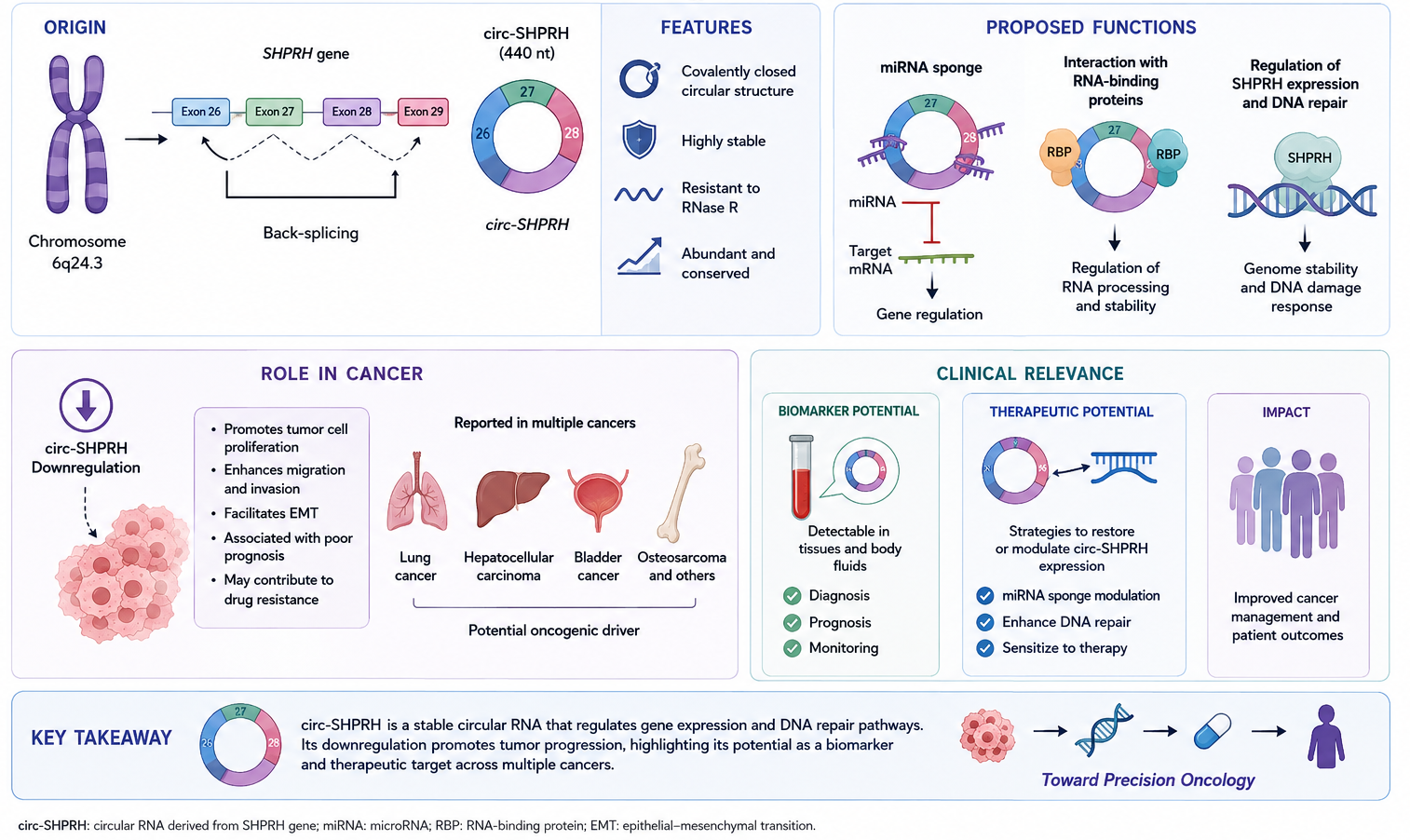
Graphical Abstract
Graphical Abstract: Novel Insights into the Role of circ-SHPRH in Human Malignant Disorders: Molecular Mechanisms and Clinical Relevance
INTRODUCTION
Circular RNAs (circRNAs) are a group of ncRNAs that form covalently closed-loop structures, which distinguish them from the linear structure of most RNA molecules. They are created by back-splicing, which creates a circular molecule lacking a 5' cap and a 3' poly(A) tail by joining a downstream splice acceptor site to an upstream splice donor site1.
CircRNAs are present in a wide variety of species and cell types and are now recognized as a diverse subclass of ncRNA molecules with important biological roles2. They are thought to be involved in the regulation of post-transcriptional genes, such as serving as miRNA sponges, controlling alternative splicing, and interacting with RNA-binding proteins (RBPs)3. It has also been demonstrated that some circRNAs are abundant and stable, which suggests that they may have potential applications as diagnostic and therapeutic biomarkers for several diseases, although further validation is required. Meanwhile, it has been found that they are necessary for the control of gene expression as well as several biological processes4. One of the recently identified circRNAs is circ-SHPRH, which is derived from the SHPRH gene, a gene involved in DNA replication and repair5.
Circ-SHPRH (circ-2Traits ID: has-circ-001599, circ-Base ID: has-circ-0001649) is a circular RNA molecule that has recently attracted attention due to its potential involvement in several human malignancies, such as hepatocellular carcinoma6, liver cancer7, and cholangiocarcinoma8. It is generated through back-splicing of exons 26–29 of the SHPRH gene (SNF2 histone linker PHD RING helicase), located at chromosomal region 6q24.3, producing a circular transcript of approximately 440 nt 9,10,9,10 (Figure 1). Evidence suggests that circ-SHPRH may regulate SHPRH gene expression, potentially forming a feedback regulatory loop during cancer development. The SHPRH gene encodes a DNA helicase and E3 ubiquitin ligase involved in maintaining genomic integrity and repairing DNA damage11. Studies have demonstrated that reduced circ-SHPRH expression has been associated with genomic instability and cancer progression in several experimental models.
Studies have shown that circSHPRH functions as a miRNA sponge, binding specific microRNAs to regulate messenger RNA (mRNA) expression5. Circ-SHPRH can efficiently regulate the expression of several target genes, including those implicated in cancer development, by binding to miRNAs12. Furthermore, current studies suggest that circ-SHPRH may participate in the regulation of DNA damage repair, an essential process for preserving genomic integrity and preventing tumor initiation11. Many human diseases share the common feature of dysregulation of DNA damage repair, such as malignancy, ageing, and neurodegenerative illnesses13. Additionally, altered circ-SHPRH expression has been reported in several malignancies and may also be associated with drug resistance in certain experimental contexts14. It has been suggested that circ-SHPRH may influence drug resistance through modulation of apoptosis and DNA repair pathways, thereby promoting cancer cell survival.
Despite growing interest in circRNAs as regulatory molecules in cancer biology, the specific molecular roles and clinical relevance of circ-SHPRH across different tumor types remain incompletely characterized. Therefore, a comprehensive synthesis of current evidence is needed. Understanding the role of circ-SHPRH in human disorders and drug resistance may provide insight into its potential relevance for cancer diagnosis and management. In this review article, we summarize current findings on the cellular functions and molecular mechanisms of circ-SHPRH in different malignancies and discuss its possible value as a candidate biomarker and therapeutic target, while highlighting existing knowledge gaps and future research directions.
CIRCRNAS BIOGENESIS and FUNCTION
CircRNAs are a type of ncRNA molecule that creates a covalently closed and continuous loop structure. They are produced by the back-splicing procedure from precursor mRNA (pre-mRNA)1. During the process of back-splicing, a downstream 5' splice site (donor site) is covalently linked to an upstream 3' splice site (acceptor site) in the pre-mRNA molecule, resulting in circular RNA molecule formation 15.
CircRNA biogenesis can occur through various mechanisms, including lariat-driven circularization, intron pairing-driven circularization, and RBP-mediated circularization16. Many factors control its synthesis, such as RBP, miRNAs, and secondary structures of RNA. These variables may have an impact on the pre-mRNA splicing pattern and circRNA synthesis. Circularization mediated by RBP is the first principle of circRNA biogenesis. Before this step, RNA polymerase II synthesizes the pre-mRNA from DNA17. Following that, the spliceosome splices the pre-mRNA, which is a complex of large ribonucleoproteins that removes introns and joins exons together to generate the mature mRNA. Then, circularization is mediated by RNA-binding proteins that recognize specific sequences and structures in the pre-mRNA18. RBPs bind to the flanking intronic regions of a pre-mRNA and promote circularization by bringing the splice sites nearby. As a result of this process, a circular RNA molecule is created without a 5' cap and a 3' poly(A) tail 19 (Figure 2. a1). The second mechanism is intron pairing-driven circularization, in which circularization is driven through base pairing interactions between the complementary sequences within the flanking intronic regions of a pre-mRNA20. This interaction brings the splice sites together and promotes circularization. Intron pairing-driven circularization can occur either in cis or trans21 (Figure 2. a2). Third, lariat-driven circularization: in this mechanism, circularization occurs through the back-splicing of a lariat intermediate18. During the splicing process, the branchpoint adenosine of the intron creates a 2',5' phosphodiester bond with the 5' splice site, resulting in the formation of a lariat intermediate22. The 3' end of the intron then undergoes a second splicing reaction, resulting in the secretion of the lariat intron and the production of a circRNA molecule23 (Figure 2 b). Many biological processes have been revealed to be significantly influenced by circRNAs, such as gene regulation , RNA splicing, and protein translation24, and their biogenesis is an active area of study in the field of molecular biology.
The circRNA's function is not yet fully understood, but studies have shown that they can control how genes are expressed by acting as regulators25. For miRNAs and other RBPs, circRNAs can serve as sponges, modulating their activity and downstream signaling pathways. Furthermore, circRNAs can regulate the splicing and transcription of other genes by interacting with RBPs or serving as scaffolds for protein complexes26. Briefly, research on the synthesis and function of circRNAs is currently ongoing. Additional studies are required to fully understand and pinpoint the range of roles that circRNAs play in gene regulation and cellular function.
CIRC-SHPRH’S STRUCTURE and FUNCTION
Circ-SHPRH is produced by the SHPRH gene on chromosome 6 in humans. It is created via back-splicing, which joins the 3' end of an upstream exon with the 5' end of a downstream exon27. In contrast to RNAs' linear structure, which results in a covalently closed molecule with free ends, this circularization produces an RNA molecule that is more stable and resistant to exonucleases28.
Circ-SHPRH has a dynamic, complicated structure that can take on several conformations based on the cellular environment and its binding partners 11. It has several RBP binding sites, including those for splicing factors and other regulatory proteins. According to certain research, circ-SHPRH can assemble RNA-protein complexes, which may play a major role in controlling the protein's biosynthesis, stability, and functionality. Although the exact role of circ-SHPRH is still unknown, recent studies have demonstrated its criticality for regulating the cell cycle and averting genomic instability29. It has been demonstrated that circ-SHPRH specifically interacts with SHPRH and inhibits the E3 ubiquitin ligase activity, which is necessary for DNA replication and repair11. Circ-SHPRH may assist in preventing DNA replication mistakes and protecting the genome from destruction by suppressing SHPRH gene activity30. Additionally, circ-SHPRH has been shown to interact not just with SHPRH but also with RBPs and splicing factors, among other proteins11. These interactions might play a major role in regulating the biogenesis of circ-SHPRH or in affecting the way other genes and pathways function within the cell. Moreover, it has been demonstrated that circ-SHPRH functions as a miRNA sponge to control the expression of other genes 31. MiRNAs specifically bind to circ-SHPRH and are then unable to bind to their intended mRNA targets, which results in the modulation of downstream gene expression and pathways31. This function implies that circ-SHPRH may have a variety of roles in maintaining cellular homeostasis and post-transcriptional gene regulation.
In brief, circ-SHPRH appears to be a complex and multifunctional molecule that may be involved in the regulation of post-transcriptional gene regulation, cell cycle progression, and genomic stability. However, further research is necessary to fully understand the mechanisms of action of circ-SHPRH as well as any possible therapeutic and diagnostic implications.
MALIGNANT DISORDERS
Circ-SHPRH has been extensively studied in malignant disorders, particularly in various types of cancer. Many types of cancer have been shown to have dysregulated circ-SHPRH, such as LC, HCC, CRC, and glioma, among others.
Dysregulation of Circ-shprh in Vitro, in Vivo, and Clinical Samples
Circ-SHPRH has been extensively studied in cell lines, animal models, and clinical samples to investigate its role in various diseases, particularly cancer (Table 1). In cell line studies, circ-SHPRH is downregulated in cancer cells compared with normal cells and acts as a tumor suppressor. According to Zhang et al., glioblastoma cells express circ-SHPRH at a lower level compared to adjacent normal brain tissues and have a 440 nt. They used deep RNA-seq with rRNA suppression to find protein-coding circRNAs. By using targeted mass spectrometry and LC-MS, the authors further confirmed that circ-SHPRH was translated into a functional SHPRH protein of 144 amino acids5. Since full-length SHPRH protein expression increased after circ-SHPRH overexpression, it appears that circ-SHPRH protects or stabilizes full-length SHPRH. Similarly, Li et al. discovered that circ-SHPRH expression was markedly diminished in GC tissue relative to their corresponding para-cancerous histologically normal tissues. The expression level of circ-SHPRH exhibited a substantial correlation with pathological differentiation, suggesting its potential as a new biomarker for the diagnosis of GC32. Likewise, Zhang et al. demonstrate that circ-SHPRH expression is repressed in glioblastoma, the SHPRH-146aa overexpression in U373 and U251 glioblastoma cells reduces their tumorigenicity and malignant behavior in vivo and in vitro5.
Furthermore, studies have shown that overexpression of circ-SHPRH can inhibit the growth and proliferation of cancer cells, suggesting that it acts as a tumor suppressor. For example, Zhou et al. showed that miR-224-5p was sponged by overexpression of circ-SHPRH to control QKI expression in BEAS-2B cells during cadmium treatment, preventing the transformation caused by cadmium9 (Figure 3a). Similarly, Su et al. revealed that circ-0001649 acts as a ceRNA to sponge miR-612, miR-4688, and miR-127-5p, thus activating SHPRH to suppress hepatocellular carcinoma progression31 (Figure 3b). Likewise, circ-SHPRH overexpression acts as a sponge for miR-942 and increases the production of BARX2, which blocks the Wnt/β-catenin signaling pathway to slow bladder cancer (BCa) development33 (Figure 3c). In addition, in osteosarcoma, Sun et al. revealed that circ-0001649 could suppress survival and viability, as well as induce apoptosis by activation of the STAT signal pathway in HOS and U2OS cells through sponging of miR-942, miR-338-5p, and miR-64734 (Figure 3d).
In animal models, circ-SHPRH is dysregulated in various types of cancer. Studies have shown that circ-SHPRH can act as a sponge for miRNAs, which are small RNA molecules that play important roles in post-transcriptional gene regulation. For instance, circ-SHPRH acts as a ceRNA to sponge miRNA-127-5p, miRNA-612, and miRNA-4688; this inhibits the progression of HCC by activating SHPRH31. Similarly, according to a study using BALB/c nude mice, circ-SHPRH works as a sponge for miRNA-942 to stop the progression of BCa by upregulating BARX2 expression and suppressing the Wnt/β-catenin signaling pathway33.
In clinical samples, there have been some studies investigating the expression of circ-SHPRH in clinical samples of several types of cancer. For instance, in NSCLC, circ-SHPRH expression was found to be significantly decreased in tumor tissues compared to adjacent normal tissues. Low circ-SHPRH expression was also associated with advanced positive lymph node metastasis, TNM stage, and unfavorable prognosis7. Similarly, in CRC, circ-SHPRH expression was significantly decreased in tumor tissues compared to normal tissues, and low circ-SHPRH expression was correlated with pathological differentiation35. Moreover, Hung et al.'s findings suggest that in OSCC patients, low plasma has-circ-0001649 was associated with patient recurrence and a poor prognosis36. Thus, has-circ-0001649 can be identified as the potential biomarker in plasma to provide information about the entire oral cavity in addition to the tumor, thereby providing a prediction for early recurrence and the second main OSCC36. Overall, the predictive biomarker has-circ-0001649 may be a useful treatment target for RB. Overall, dysregulation of circ-SHPRH in cell lines, animal models, and clinical samples suggests that circ-SHPRH may play a critical role in the development and progression of various diseases, particularly cancer and drug resistance, and may serve as a potential diagnostic and therapeutic target.
| Types of cancer | Roles/ Expression | Functional activities | Target miRNA/ related genes and signaling pathway | Cell line (in vitro) study | Animal (in vivo) study | Clinical study | Associated phenotype with dysregulated Circ-SHPRH | Clinical Importance | Ref. |
|---|---|---|---|---|---|---|---|---|---|
| Lung cancer | Tumor-suppressing/ downregulated | Proliferation, viability migration and invasion | miRNA-338-5p, miR-331-3p | H1581, A549, H1299, H358, 16HBE | BALB/c nude mice | 53 paired sample | Lymph node metastasis, TNM stage | Prognostic, biomarker | 7 |
| Tumor-suppressing/ downregulated | Proliferation, migration and invasion, EMT | miRNA-224–5p/ QKI | BEAS-2B | - | - | - | - | 9 | |
| Hepatocellular carcinoma | Tumor-suppressing/ downregulated | Tumorigenesis, metastasis | - | HCC-LM3, MHCC-97L | - | 89 paired samples | Pathological differentiation | Diagnosis, Biomarker | 6 |
| Tumor-suppressing/ downregulated | Proliferation, apoptosis, migration and invasion | - | MHCC97L, HepG2, HCCLM, HCCLM9 | - | 77 paired samples | Lymph node metastasis, TNM stage | Diagnosis, Biomarker | 37 | |
| Tumor-suppressing/ downregulated | Proliferation, cell viability, migration | miR-4688, miR-127-5p, miR-612 | SMMC-7721, H-97, HHCC, HepG2, HL-7702, HuH-7, Li-7, HepG2.2.15 | Nude mice | 84 paired sample | Tumor satellite, grade of differentiation | - | 31 | |
| Gastric cancer | Tumor-suppressing/ downregulated | - | - | SGC-7901 | - | 76 paired sample | Pathological differentiation | Diagnosis, Biomarker | 32 |
| Tumor-suppressing/ downregulated | Proliferation, migration, and invasion, Viability | miRNA-20a | GES-1, SGC-7901, MKN28, AGS, MKN28, MKN45 | - | 25 sample | - | Diagnosis, Biomarker | 38 | |
| Cholangiocarcinoma cells | Tumor-suppressing/ downregulated | Proliferation, Migration, invasion | - | RBE, HCCC-9810, HuCCT1, CCLP1, Huh-28, QBC939, KMBC, HIBEC | BALB/c nude mice | 532 sample | Tumor size, Lymph node invasion, TNM stage, differentiation grade | - | 8 |
| Pancreatic ductal adenocarcinoma | Tumor-suppressing/ downregulated | Proliferation, colony-formation, apoptosis | - | PANC1, SW1990, BxPC3, Capan-2, HPDE | - | 58 paired sample | Grade of differentiation, tumor stage | Prognostic Biomarker | 39 |
| Retinoblastoma | Tumor-suppressing/ downregulated | Proliferation, apoptosis | AKT/ mTOR signaling | HXO-RB44, ARPE-19, SO-Rb50 | Nude mice | 60 RB tissues + 6 control | IIRC stage, tumor size | Prognostic Biomarker | 40 |
| Glioma | Tumor-suppressing/ downregulated | Cell proliferation, cell apoptosis | Caspase-9, Caspase-3, Bax, Bcl-2 | U118, U87 MG, LN229, U251, NHA | BALB/c nude mice | 64 paired sample | WHO grade, Tumor size | Prognostic Biomarker | 41 |
| Tumor-suppressing/ downregulated | Proliferation, tumorigenicity | - | - | nude mice | 60 sample | - | Prognostic Biomarker | 5 | |
| Osteosarcoma | Tumor-suppressing/ downregulated | Cell apoptosis, cell viability | miRNA-942, miRNA-647, miRNA-338-5p / CDK6, Apaf-1, CDK4, STAT3, Caspase-9, STAT5, Caspase-3, STAT signaling pathway | MG63, U2OS, HOS, Saos-2 | - | 26 paired sample | - | Prognostic Biomarker | 34 |
| Bladder cancer | Tumor-suppressing/ downregulated | Cell proliferation, invasion, migration | miRNA-942/ BARX2, Wnt/β-catenin pathway | EJ, T24, SV-HUC-1,5637, J82, UM-UC-3 | BALB/c nude mice | - | T-stage, lymph node metastasis | - | 33 |
| Oral squamous cell carcinoma | Tumor-suppressing/ downregulated | Tumor growth | - | OECM1 | - | 66 OSCC sample + 30 control | lymph node metastasis | Prognostic biomarker | 36 |
| Colorectal cancer | Tumor-suppressing/ downregulated | Tumorigenesis | - | H116 | - | 64 paired sample | Pathological differentiation | Biomarker | 35 |
CIRC-SHPRH-RELATED SIGNALING PATHWAY in HUMAN CANCER
Numerous signaling pathways associated with the onset and advancement of cancer have been connected to circ-SHPRH. One such pathway is the Wnt signaling pathway. Wnt signaling is frequently dysregulated in cancer and is involved in a variety of biological processes, such as cell division, migration, and proliferation37. Studies have shown that knockdown of circ-SHPRH activates the Wnt/β-catenin pathway by regulating BARX2 expression. Taken together, Zuo et al.'s findings revealed that circ-SHPRH serves as a miRNA-942 sponge to prevent BCa progression via BARX2 upregulation, thereby suppressing the Wnt/β-catenin signaling pathway33. One more pathway is the STAT signaling pathway in osteosarcoma. Sun et al. found that circ-SHPRH promoted cell death through sponging of miRNA-338-5p, miRNA-647, and miRNA-942, as well as suppressed the STAT pathway and osteosarcoma cell proliferation34. Further, circ-0001649, which controls cell growth and death through the AKT/mTOR pathway, is downregulated, which implies a poor prognosis for retinoblastoma42.
Overall, these findings suggest that circ-SHPRH may be extremely important in the initiation and development of human cancer by regulating several keys signaling pathways that participate in cell differentiation, proliferation, and survival. To fully comprehend the processes of action and possible clinical applications of circ-SHPRH in cancer therapy, further research is required.
DIAGNOSTIC and THERAPEUTIC POTENTIAL of CIRC-SHPRH
Circ-SHPRH, as a non-coding RNA, can be a cancer therapeutic and diagnostic target. Numerous studies on different cancer types have found dysregulated expression of circ-SHPRH, which suggests that circ-SHPRH could be a useful biomarker for cancer diagnosis. For example, the expression level of circ-SHPRH, which is diminished in HCC, has been shown to correlate with lymph node metastases, TNM stage, and patient prognosis43. Additionally, GC shows higher circ-SHPRH expression, which has been linked to pathological differentiatio32. According to these findings, circ-SHPRH may be used as a diagnostic marker in different kinds of cancer. Circ-SHPRH is a promising therapeutic target due to its role in regulating numerous signaling pathways linked to cancer development and progression. Numerous studies have shown that changes in the expression levels of circ-SHPRH can impact the migration, invasion, and proliferation of tumor cells. For instance, it has been demonstrated that overexpression of circ-SHPRH inhibits the spread and invasion of bladder cancer cells in both in vivo and in vitro33models. Furthermore, it was found that glioma cell migration and proliferation were increased by circ-SHPRH knockdown40. These results suggest that circ-SHPRH could be a promising target for cancer therapy. However, further investigation is needed to understafully comprehend the mechanisms of circ-SHPRH in cancer and to develop safe and effective therapeutic strategies.
THERAPEUTIC TARGETS
Research has shown the tumor-suppressive characteristics of circ-SHPRH, and enhancing their expression may provide an innovative therapeutic approach for cancer treatment. CircRNA expression can be increased by a variety of therapeutic strategies, such as CRISPR/Cas9 genome editing41, small molecule drugs44, antisense oligonucleotides (ASOs)45, and gene therapy46. Exosomes and nanoparticles have been widely employed as delivery vehicles because of their capacity to increase cellular absorption and prevent the therapeutic cargo from degrading to transport these molecules to the target site. Numerous investigations have confirmed the effectiveness of ASO delivery using nanoparticles47 to boost the expression of circ-SHPRH in the tumor mass.
For example, artificially synthesized compounds known as ASOs can attach to particular sequences of RNA and cause splicing modification or RNA destruction. ASOs can be made to specifically target the circ-SHPRH intronic or exonic regions to encourage splicing and circularization, which will boost circ-SHPRH expression17. Additionally, ASOs can be engineered to attach to the RNA-binding proteins that control and stabilize the expression of circ-SHPRH48. Likewise, splicing and circularization of circ-SHPRH can be induced by CRISPR-Cas9, leading to elevated expression49. Alternatively, it can be applied to boost the expression of circ-SHPRH by deleting or altering the regulatory sequences that regulate its expression.
Furthermore, using synthetic circRNAs is another method of producing more circ-SHPRH. One strategy for creating a synthetic circRNA to boost circSHPRH expression would be to first determine the circSHPRH sequence and then make changes to improve its expression, stability, and functionality. To enhance stability and expression, the synthetic circRNA can be engineered to match the endogenous circSHPRH50sequence. Another strategy is to create a synthetic circRNA that targets and sequesters miRNAs that control the production of circ-SHPRH. The synthetic circRNA can indirectly upregulate circ-SHPRH expression by sequestering these miRNAs51. Moreover, gene therapy involves delivering beneficial genes to tissues or cells to treat or prevent disease. The expression of the circ-SHPRH gene may be enhanced by introducing it into cancer cells, which may decrease tumor growth52. It should be noted that while these approaches hold promise for increasing circ-SHPRH expression, more research is needed to validate their effectiveness and safety in the context of cancer therapy.
CONCLUSION and FUTURE PERSPECTIVES
Circ-SHPRH is an emerging biomolecule that has been demonstrated to be involved in cancer progression, and current evidence from several studies suggests that it predominantly functions as a tumor suppressor in multiple malignancies. Studies have demonstrated that circ-SHPRH may inhibit tumor growth by regulating gene expression associated with tumor cell proliferation, DNA damage repair, and apoptosis-related pathways. Therefore, modulation of circ-SHPRH expression represents a potential therapeutic strategy; however, most supporting evidence is currently derived from experimental studies and requires further clinical validation. Several strategies, such as ASOs, miRNA-based approaches, and circRNA sponges, are being explored.
Despite the advancements achieved in our comprehension of the function of circ-SHPRH in cancer, several unanswered concerns and challenges remain. Further research is needed to identify additional circ-SHPRH targets and elucidate their roles in cancer development. Importantly, larger clinical cohort studies and additional mechanistic investigations are required to confirm its biological and clinical relevance across different tumor types. Also, the clinical success of circ-SHPRH-targeting strategies will depend on improvements in delivery efficiency and specificity. There is still more research required to completely understand the mechanisms underlying the regulation of circ-SHPRH expression. Moreover, the creation of diagnostic tools to identify patients who might benefit from circ-SHPRH-targeted therapy, as well as the planning of clinical trials to assess the treatment's safety and efficacy, will be necessary before circ-SHPRH can be considered for routine clinical application.
However, future discoveries about circ-SHPRH may have important implications for cancer treatment strategies. The effectiveness of current cancer medicines may potentially be improved by the development of safe and efficient circ-SHPRH-targeting techniques, and the introduction of circ-SHPRH-targeted therapy into clinical practice will depend on further preclinical and clinical validation. Thus, more well-designed experimental and clinical research on circ-SHPRH is necessary to completely comprehend its function in cancer and support the development of evidence-based therapeutic approaches targeting this molecule.
DECLARATIONS
Data Availability Statement
No new data were generated or analyzed in this review article.
Funding
The authors declare that no funding was received for this work.
Ethics Approval and Consent to Participate
Not applicable.
Conflict of Interest
The authors declare no conflict of interest.
Use of Generative AI
Generative AI tools were used only for language improvement and proofreading. The authors reviewed and approved the final content and take full responsibility for the manuscript.
Acknowledgments
We gratefully acknowledge the co-workers of our team.
Reference
- HussenBashdar Mahmud, AbdullahSnur Rasool, Hama FarajGoran Sedeeq, RasulMohammed Fatih, SalihiAbbas, Ghafouri-FardSoudeh, TaheriMohammad, MokhtariMajid. Exosomal circular RNA: a signature for lung cancer progression. Cancer Cell International. 2022;22(1). https://doi.org/10.1186/s12935-022-02793-7
- AufieroSimona, ReckmanYolan J., PintoYigal M., CreemersEsther E.. Circular RNAs open a new chapter in cardiovascular biology. Nature Reviews Cardiology. 2019;16(8):503–514. https://doi.org/10.1038/s41569-019-0185-2
- ZangJiankun, LuDan, XuAnding. The interaction of circRNAs and RNA binding proteins: An important part of circRNA maintenance and function. Journal of Neuroscience Research. 2018;98(1):87–97. https://doi.org/10.1002/jnr.24356
- HussenBashdar Mahmud, MohamadtahrSayran, AbdullahSnur Rasool, HidayatHazha Jamal, RasulMohammad Fatih, Hama FarajGoran Sedeeq, Ghafouri-FardSoudeh, TaheriMohammad, KhayamzadehMaryam, JamaliElena. Exosomal circular RNAs: New player in breast cancer progression and therapeutic targets. Frontiers in Genetics. 2023;14. https://doi.org/10.3389/fgene.2023.1126944
- ZhangMaolei, HuangNunu, YangXuesong, LuoJingyan, YanSheng, XiaoFeizhe, ChenWenping, GaoXinya, ZhaoKun, ZhouHuangkai, LiZiqiang, MingLiu, XieBo, ZhangNu. A novel protein encoded by the circular form of the SHPRH gene suppresses glioma tumorigenesis. Oncogene. 2018;37(13):1805–1814. https://doi.org/10.1038/s41388-017-0019-9
- QinMeilin, LiuGang, HuoXisong, TaoXuemei, SunXiaomeng, GeZhouhong, YangJuan, FanJia, LiuLei, QinWenxin. Hsa_circ_0001649: A circular RNA and potential novel biomarker for hepatocellular carcinoma. Cancer Biomarkers. 2016;16(1):161–169. https://doi.org/10.3233/cbm-150552
- LiuTongmiao, SongZhuo, GaiYanling. Circular RNA circ_0001649 acts as a prognostic biomarker and inhibits NSCLC progression via sponging miR-331-3p and miR-338-5p. Biochemical and Biophysical Research Communications. 2018;503(3):1503–1509. https://doi.org/10.1016/j.bbrc.2018.07.070
- XuYi, YaoYue, ZhongXiangyu, LengKaiming, QinWei, QuLijun, CuiYunfu, JiangXingming. Downregulated circular RNA hsa_circ_0001649 regulates proliferation, migration and invasion in cholangiocarcinoma cells. Biochemical and Biophysical Research Communications. 2018;496(2):455–461. https://doi.org/10.1016/j.bbrc.2018.01.077
- ZhouMei, LiLuyao, ChenBiyun, PanShuya, TuWei, HouYaxuan, ChenPanpan, HernándezRodolfo Rochín, ZhouXue. Circ-SHPRH suppresses cadmium-induced transformation of human bronchial epithelial cells by regulating QKI expression via miR-224–5p. Ecotoxicology and Environmental Safety. 2021;220:112378. https://doi.org/10.1016/j.ecoenv.2021.112378
- SoodRaman, MakalowskaIzabela, GaldzickiMichal, HuPing, EddingsErica, RobbinsChristiane M, MosesTracy, NamkoongJin, ChenSuzie, TrentJeffrey M. Cloning and characterization of a novel gene, SHPRH, encoding a conserved putative protein with SNF2/helicase and PHD-finger domains from the 6q24 region☆. Genomics. 2003;82(2):153–161. https://doi.org/10.1016/s0888-7543(03)00121-6
- BrühlJoanna, TrautweinJonathan, SchäferAgnes, LinneUwe, BouazouneKarim. The DNA repair protein SHPRH is a nucleosome-stimulated ATPase and a nucleosome-E3 ubiquitin ligase. Epigenetics & Chromatin. 2019;12(1):1–16. https://doi.org/10.1186/s13072-019-0294-5
- JuXinyue, TangYan, QuRongfeng, HaoShuhong. The Emerging Role of Circ-SHPRH in Cancer. OncoTargets and Therapy. 2021;Volume 14:4177–4188. https://doi.org/10.2147/ott.s317403
- WelchGwyneth, TsaiLi‐Huei. Mechanisms of DNA damage‐mediated neurotoxicity in neurodegenerative disease. The EMBO Reports. 2022;23(6). https://doi.org/10.15252/embr.202154217
- FangShuai, PanJinchang, ZhouChengwei, TianHui, HeJinxian, ShenWeiyu, JinXiaofeng, MengXiaodan, JiangNan, GongZhaohui. Circular RNAs Serve as Novel Biomarkers and Therapeutic Targets in Cancers. Current Gene Therapy. 2019;19(2):125–133. https://doi.org/10.2174/1566523218666181109142756
- HussenBashdar Mahmud, MohamadtahrSayran, AbdullahSnur Rasool, HidayatHazha Jamal, RasulMohammad Fatih, Hama FarajGoran Sedeeq, Ghafouri-FardSoudeh, TaheriMohammad, KhayamzadehMaryam, JamaliElena. Exosomal circular RNAs: New player in breast cancer progression and therapeutic targets. Frontiers in Genetics. 2023;14. https://doi.org/10.3389/fgene.2023.1126944
- ZhaoXian, ZhongYouxiu, WangXudong, ShenJiuheng, AnWenlin. Advances in Circular RNA and Its Applications. International Journal of Medical Sciences. 2022;19(6):975–985. https://doi.org/10.7150/ijms.71840
- MumtazPeerzada Tajamul, TabanQamar, DarMashooq Ahmad, MirShabir, HaqZulfkar ul, ZargarSajad Majeed, ShahRiaz Ahmad, AhmadSyed Mudasir. Deep Insights in Circular RNAs: from biogenesis to therapeutics. Biological Procedures Online. 2020;22(1):1–16. https://doi.org/10.1186/s12575-020-00122-8
- LiJiao, SunDan, PuWenchen, WangJin, PengYong. Circular RNAs in Cancer: Biogenesis, Function, and Clinical Significance. Trends in Cancer. 2020;6(4):319–336. https://doi.org/10.1016/j.trecan.2020.01.012
- QuanGuobo, LiJulang. Circular RNAs: biogenesis, expression and their potential roles in reproduction. Journal of Ovarian Research. 2018;11(1):1–12. https://doi.org/10.1186/s13048-018-0381-4
- WeldenJustin R., StammStefan. Pre-mRNA structures forming circular RNAs. Biochimica et Biophysica Acta (BBA) - Gene Regulatory Mechanisms. 2019;1862(11-12):194410. https://doi.org/10.1016/j.bbagrm.2019.194410
- YaoTing, ChenQingqing, FuLiyun, GuoJunming. Circular RNAs: Biogenesis, properties, roles, and their relationships with liver diseases. Hepatology Research. 2017;47(6):497–504. https://doi.org/10.1111/hepr.12871
- LeeKyung Hyun, KimSeongcheol, LeeSeong-Wook. Pros and Cons of In Vitro Methods for Circular RNA Preparation. International Journal of Molecular Sciences. 2022;23(21):13247. https://doi.org/10.3390/ijms232113247
- EgerNicole, SchoppeLaura, SchusterSusanne, LaufsUlrich, BoeckelJes-Niels. Circular RNA Splicing. Advances in Experimental Medicine and Biology. 2018:41–52. https://doi.org/10.1007/978-981-13-1426-1_4
- ShiY., JiaX., XuJ.. The new function of circRNA: translation. Clinical and Translational Oncology. 2020;22(12):2162–2169. https://doi.org/10.1007/s12094-020-02371-1
- QuShibin, LiuZhengcai, YangXisheng, ZhouJingshi, YuHengchao, ZhangRui, LiHaimin. The emerging functions and roles of circular RNAs in cancer. Cancer Letters. 2018;414:301–309. https://doi.org/10.1016/j.canlet.2017.11.022
- JiangMeng-Ping, XuWen-Xiu, HouJun-Chen, XuQi, WangDan-Dan, TangJin-Hai. The Emerging Role of the Interactions between Circular RNAs and RNA-binding Proteins in Common Human Cancers. Journal of Cancer. 2021;12(17):5206–5219. https://doi.org/10.7150/jca.58182
- RuanHang, WangPeng‐Cheng, HanLeng. Characterization of circular RNAs with advanced sequencing technologies in human complex diseases. WIREs RNA. 2022;14(1). https://doi.org/10.1002/wrna.1759
- SzczepaniakAdrian, BroniszAgnieszka, GodlewskiJakub. Circular RNAs—New Kids on the Block in Cancer Pathophysiology and Management. Cells. 2023;12(4):552. https://doi.org/10.3390/cells12040552
- BiswasAniruddha, ChowdhuryNilkanta, BagchiAngshuman. Structural Characterization of the Hidden Peptide SHPRH-146aa Encoded by Non-Coding circ-SHPRH to Act as Tumor Suppressor. Applied Biochemistry and Biotechnology. 2021;193(7):2076–2086. https://doi.org/10.1007/s12010-021-03520-0
- KrijgerPeter H.L., LeeKyoo-Young, WitNiek, van den BerkPaul C.M., WuXiaoli, RoestHenk P., MaasAlex, DingHao, HoeijmakersJan H.J., MyungKyungjae, JacobsHeinz. HLTF and SHPRH are not essential for PCNA polyubiquitination, survival and somatic hypermutation: Existence of an alternative E3 ligase. DNA Repair. 2011;10(4):438–444. https://doi.org/10.1016/j.dnarep.2010.12.008
- SuYang, XuChao, LiuYuting, HuYilin, WuHaiyan. Circular RNA hsa_circ_0001649 inhibits hepatocellular carcinoma progression via multiple miRNAs sponge. Aging. 2019;11(10):3362–3375. https://doi.org/10.18632/aging.101988
- LiWen-han, SongYong-chun, ZhangHao, ZhouZhang-jian, XieXin, ZengQing-nuo, GuoKun, WangTing, XiaPeng, ChangDong-min. Decreased Expression of Hsa_circ_00001649 in Gastric Cancer and Its Clinical Significance. Disease Markers. 2017;2017:1–6. https://doi.org/10.1155/2017/4587698
- ZuoLing, ZhuYi, HanJinli, LiuHongwei. Circular RNA circSHPRH inhibits the malignant behaviors of bladder cancer by regulating the miR-942/BARX2 pathway. Aging. 2022;14(4):1891–1909. https://doi.org/10.18632/aging.203911
- SunDeping, ZhuDongsheng. Circular RNA hsa_circ_0001649 suppresses the growth of osteosarcoma cells via sponging multiple miRNAs. Cell Cycle. 2020;19(20):2631–2643. https://doi.org/10.1080/15384101.2020.1814026
- JiWenxin, QiuChunli, WangMao, MaoNing, WuShaofeng, DaiYinhai. Hsa_circ_0001649: A circular RNA and potential novel biomarker for colorectal cancer. Biochemical and Biophysical Research Communications. 2018;497(1):122–126. https://doi.org/10.1016/j.bbrc.2018.02.036
- HungKai-Feng, ChenBing-Hong, WangTsui-Ying, YangYi-Ping, ChienYueh, LoJeng-Fan, YangLin, PengBou-Yue, KaoShou-Yen, WuCheng-Hsien. Identification of plasma hsa_circ_0000190 and 0001649 as biomarkers for predicting the recurrence and treatment response of patients with oral squamous cell carcinoma. Journal of the Chinese Medical Association. 2022;85(4):431–437. https://doi.org/10.1097/jcma.0000000000000700
- HuXiao-Yi, HouPing-Fu, LiTeng-Teng, QuanHao-Yu, LiMin-Le, LinTian, LiuJin-Jin, BaiJin, ZhengJun-Nian. The roles of Wnt/β-catenin signaling pathway related lncRNAs in cancer. International Journal of Biological Sciences. 2018;14(14):2003–2011. https://doi.org/10.7150/ijbs.27977
- SunHaiyuan, WangQunying, YuanGang, QuanJingzi, DongDongfang, LunYue, SunBo. Hsa_circ_0001649 restrains gastric carcinoma growth and metastasis by downregulation of miR‐20a. Journal of Clinical Laboratory Analysis. 2020;34(6). https://doi.org/10.1002/jcla.23235
- JiangYuehong, WangTong, YanLi, QuLijuan. A novel prognostic biomarker for pancreatic ductal adenocarcinoma: hsa_circ_0001649. Gene. 2018;675:88–93. https://doi.org/10.1016/j.gene.2018.06.099
- WangYu, SuiXin, ZhaoHong, CongLing, LiYu, XinTing, GuoMingxing, HaoWenbo. Decreased circular RNA hsa_circ_0001649 predicts unfavorable prognosis in glioma and exerts oncogenic properties in vitro and in vivo. Gene. 2018;676:117–122. https://doi.org/10.1016/j.gene.2018.07.037
- SanterLaura, BärChristian, ThumThomas. Circular RNAs: A Novel Class of Functional RNA Molecules with a Therapeutic Perspective. Molecular Therapy. 2019;27(8):1350–1363. https://doi.org/10.1016/j.ymthe.2019.07.001
- XingLichen, ZhangLeiming, FengYali, CuiZhe, DingLin. Downregulation of circular RNA hsa_circ_0001649 indicates poor prognosis for retinoblastoma and regulates cell proliferation and apoptosis via AKT/mTOR signaling pathway. Biomedicine & Pharmacotherapy. 2018;105:326–333. https://doi.org/10.1016/j.biopha.2018.05.141
- ZhangXianwei, QiuShili, LuoPing, ZhouHu, JingWei, LiangChuizi, TuJiancheng. Down-regulation of hsa_circ_0001649 in hepatocellular carcinoma predicts a poor prognosis. Cancer Biomarkers. 2018;22(1):135–142. https://doi.org/10.3233/cbm-171109
- ZhaoRongyan, FuJiahui, ZhuLingjuan, ChenYi, LiuBo. Designing strategies of small-molecule compounds for modulating non-coding RNAs in cancer therapy. Journal of Hematology & Oncology. 2022;15(1):1–19. https://doi.org/10.1186/s13045-022-01230-6
- ZhangYunjing, WangYing, SuXinwan, WangPing, LinWeiqiang. The Value of Circulating Circular RNA in Cancer Diagnosis, Monitoring, Prognosis, and Guiding Treatment. Frontiers in Oncology. 2021;11. https://doi.org/10.3389/fonc.2021.736546
- DuWilliam W, ZhangChao, YangWeining, YongTianqiao, AwanFaryal Mehwish, YangBurton B. Identifying and Characterizing circRNA-Protein Interaction. Theranostics. 2017;7(17):4183–4191. https://doi.org/10.7150/thno.21299
- HeAlina T., LiuJinglei, LiFeiya, YangBurton B.. Targeting circular RNAs as a therapeutic approach: current strategies and challenges. Signal Transduction and Targeted Therapy. 2021;6(1). https://doi.org/10.1038/s41392-021-00569-5
- ObiPrisca, ChenY. Grace. The design and synthesis of circular RNAs. Methods. 2021;196:85–103. https://doi.org/10.1016/j.ymeth.2021.02.020
- KristensenLasse S., AndersenMaria S., StagstedLotte V. W., EbbesenKaroline K., HansenThomas B., KjemsJørgen. The biogenesis, biology and characterization of circular RNAs. Nature Reviews Genetics. 2019;20(11):675–691. https://doi.org/10.1038/s41576-019-0158-7
- MiaoQingqing, NiBing, TangJun. Coding potential of circRNAs: new discoveries and challenges. PeerJ. 2021;9. https://doi.org/10.7717/peerj.10718
- BreuerJanina, RossbachOliver. Production and Purification of Artificial Circular RNA Sponges for Application in Molecular Biology and Medicine. Methods and Protocols. 2020;3(2):42. https://doi.org/10.3390/mps3020042
- HoldtLesca M., KohlmaierAlexander, TeupserDaniel. Circular RNAs as Therapeutic Agents and Targets. Frontiers in Physiology. 2018;9. https://doi.org/10.3389/fphys.2018.01262