
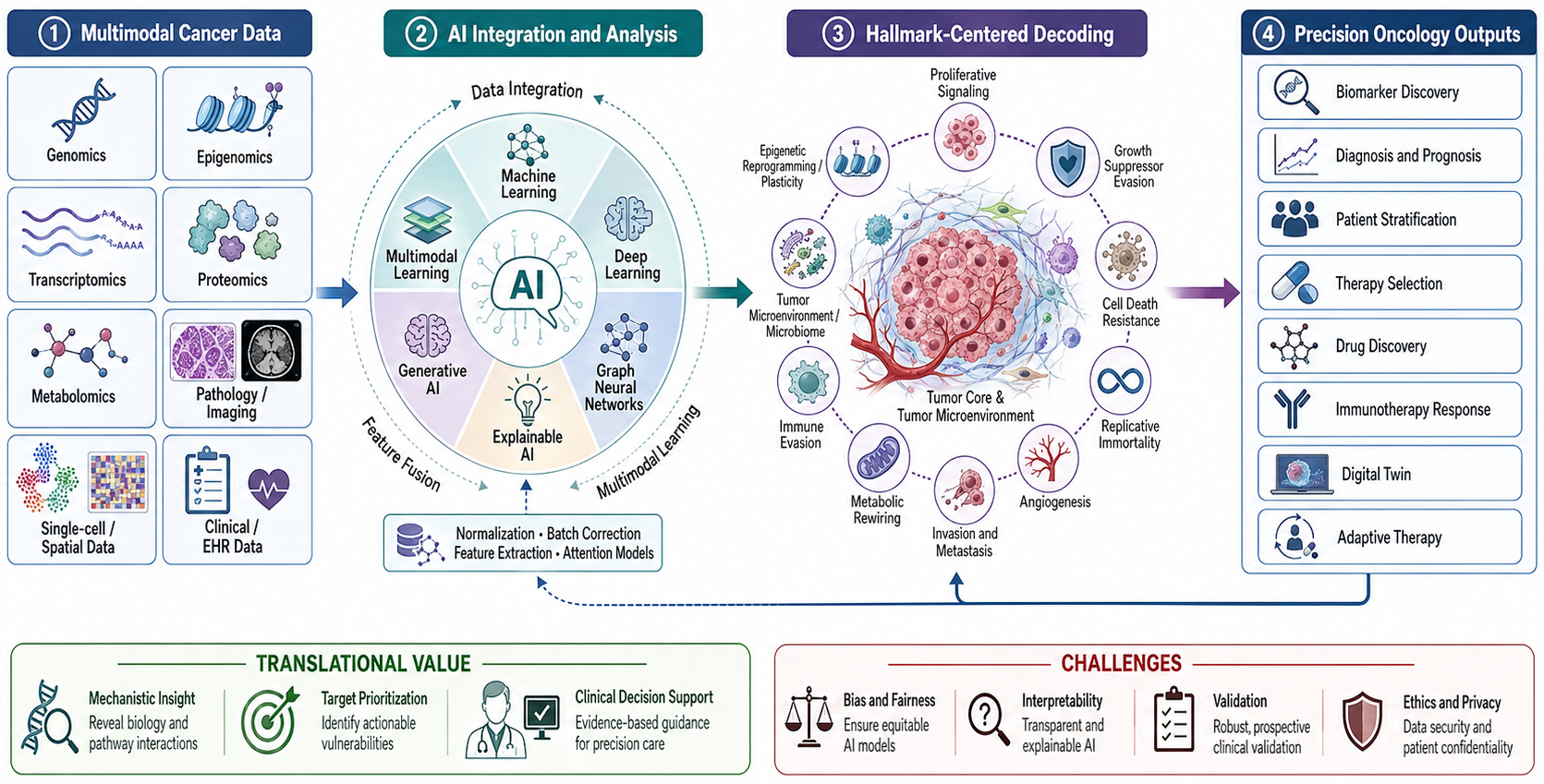
Graphical Abstract
Graphical Abstract: Hallmarks of Cancer in the Age of Artificial Intelligence
INTRODUCTION
Cancer remains one of the leading causes of morbidity and mortality worldwide, imposing a substantial and growing global health burden1. Despite significant advances in prevention, early detection, and therapeutic strategies, cancer incidence continues to rise due to population aging, environmental exposures, and lifestyle factors2. Conventional treatment paradigms, largely based on histopathological classification and limited molecular markers, often fail to capture the profound heterogeneity that characterizes tumor biology3. This heterogeneity underlies variable treatment responses and clinical outcomes, highlighting the urgent need for precision oncology approaches that integrate molecular, cellular, and clinical data to guide individualized patient management4. In this context, AI has emerged as a transformative tool in biomedical research and clinical oncology5. Advances in machine learning, deep learning, and data science have enabled the analysis of complex, high-dimensional datasets, including genomics, transcriptomics, proteomics, imaging, and electronic health records. AI-driven models can uncover hidden patterns, predict disease trajectories, and optimize therapeutic decision-making with unprecedented accuracy6. These capabilities position AI at the forefront of efforts to address the complexity of cancer as a dynamic and multifactorial disease.
A conceptual framework that has profoundly shaped our understanding of tumor biology is the Hallmarks of Cancer7, originally proposed by Hanahan and Weinberg and subsequently expanded to reflect emerging insights into cancer complexity. This framework defines a set of core biological capabilities acquired during tumor development, including sustained proliferative signaling, resistance to cell death, angiogenesis, invasion and metastasis, metabolic reprogramming, and immune evasion, along with enabling characteristics such as genomic instability and tumor-promoting inflammation8. More recent refinements have introduced additional dimensions, including cellular plasticity, epigenetic reprogramming, and the influence of the tumor microenvironment and microbiome, emphasizing cancer as a highly adaptive and evolving system9,10,9,10.
Despite these conceptual advances, translating the hallmarks framework into actionable clinical strategies remains challenging due to the intricate, interconnected nature of these processes. Here, AI offers a powerful integrative platform capable of mapping multidimensional biological data onto hallmark-driven models of cancer. By bridging molecular mechanisms with clinical phenotypes, AI has the potential to transform the hallmarks from a descriptive paradigm into a predictive and actionable framework. Accordingly, this review aims to explore the intersection between AI and the evolving hallmarks of cancer, highlighting how AI-driven approaches can redefine our understanding of tumor biology and accelerate the development of next-generation precision oncology.
EVOLUTION of the HALLMARKS of CANCER FRAMEWORK
The Hallmarks of Cancer framework represents one of the most influential conceptual advances in oncology, providing a unifying schema that links diverse genetic and epigenetic alterations to a finite set of functional capabilities required for malignant transformation. Since its initial formulation, the framework has undergone iterative refinement in response to rapid progress in molecular biology, systems oncology, and tumor ecology. This evolution reflects a shift from a predominantly tumor cell–centric model toward a multidimensional and dynamic understanding of cancer as a complex, adaptive biological system.
The Original Hallmarks (2000)
In their landmark 2000 synthesis, Hanahan and Weinberg7 proposed that the vast heterogeneity of cancer could be distilled into six essential biological capabilities acquired during multistep tumorigenesis. These included sustained proliferative signaling, whereby cancer cells achieve autonomy from exogenous growth cues through constitutive activation of oncogenic pathways such as RAS–MAPK and PI3K–AKT. Complementing this, tumor cells exhibit evasion of growth suppressors, disabling critical checkpoint regulators including TP53 and RB, thereby uncoupling proliferation from normal tissue constraints. A third hallmark, resistance to apoptosis, reflects the capacity of cancer cells to circumvent programmed cell death through dysregulation of intrinsic and extrinsic apoptotic pathways, often via modulation of BCL-2 family proteins and caspases. In parallel, tumors acquire replicative immortality, typically through activation of telomerase or alternative lengthening of telomeres (ALT), enabling indefinite proliferative potential.
The induction of angiogenesis constitutes another critical adaptation, allowing tumors to secure a sustained supply of oxygen and nutrients through pro-angiogenic factors such as vascular endothelial growth factor (VEGF). Finally, activation of invasion and metastasis enables dissemination beyond the primary tumor site, involving complex processes such as epithelial–mesenchymal transition (EMT), extracellular matrix remodeling, and cytoskeletal reorganization. Collectively, these six hallmarks established a robust framework linking molecular aberrations to phenotypic traits that define malignancy.
The Next Generation (2011)
A decade of subsequent research necessitated expansion of the framework to incorporate emerging insights into cancer metabolism, immune surveillance, and genomic instability. Two additional hallmarks were introduced8. The first, reprogramming of energy metabolism, recognizes the metabolic plasticity of cancer cells, exemplified by the Warburg effect, wherein glycolysis is favored even under normoxic conditions. Beyond glycolysis, tumors exhibit adaptive rewiring of lipid, amino acid, and mitochondrial metabolism to sustain biosynthetic and bioenergetic demands.
The second addition, evasion of immune destruction, reflects the ability of tumor cells to avoid recognition and elimination by the host immune system. Mechanisms include downregulation of antigen presentation machinery, secretion of immunosuppressive cytokines, and exploitation of immune checkpoint pathways such as PD-1/PD-L1 and CTLA-4. Importantly, the 2011 update also introduced two enabling characteristics that facilitate the acquisition of hallmark capabilities. Genome instability and mutation generate the genetic diversity necessary for clonal selection and tumor evolution, while tumor-promoting inflammation provides a supportive microenvironment enriched in growth factors, survival signals, and pro-angiogenic mediators. This expanded framework underscored the interplay between intrinsic genetic alterations and extrinsic microenvironmental influences in driving tumor progression.
New Dimensions (2022)
Recent conceptual advances have further refined the hallmarks paradigm by incorporating insights from epigenetics, tumor ecology, and cellular dynamics9. A central addition is epigenetic reprogramming, which enables heritable yet reversible modulation of gene expression through mechanisms such as DNA methylation, histone modification, and chromatin remodeling. These processes contribute to tumor heterogeneity, lineage plasticity, and therapeutic resistance without requiring changes in DNA sequence. Another critical dimension is the Tumor Microenvironment (TME), now recognized as an active participant in cancer progression rather than a passive scaffold. The TME comprises a heterogeneous assembly of stromal cells, immune infiltrates, endothelial cells, and extracellular matrix components, all of which engage in bidirectional signaling with tumor cells. This crosstalk shapes key processes including angiogenesis, immune evasion, and metastatic dissemination.
The concept of cellular plasticity has also emerged as a defining feature of malignancy. Cancer cells can dynamically transition between differentiated and stem-like states, as well as between epithelial and mesenchymal phenotypes, enabling adaptation to environmental stress and therapeutic pressure. In parallel, the microbiome has been implicated as a modulator of tumorigenesis, influencing inflammation, immune responses, metabolism, and even the efficacy of anticancer therapies. These additions collectively expand the hallmarks framework into a more integrative model encompassing both genetic and non genetic determinants of cancer behavior.
Emerging Concepts (2025–2026)
The most recent conceptual developments move beyond discrete hallmark categories toward a systems-level paradigm that conceptualizes cancer as a dynamic, evolving ecosystem10. Within this framework, tumors are understood as complex multicellular communities, characterized by spatial and temporal heterogeneity and governed by intricate networks of intercellular communication. These include paracrine signaling, metabolic coupling, extracellular vesicle exchange, and immune modulation. A key feature of this emerging perspective is the recognition of intercellular interactions as fundamental drivers of tumor behavior. Cooperative and competitive dynamics among cancer subclones, stromal elements, and immune populations contribute to adaptive evolution, therapeutic resistance, and metastatic potential. Moreover, cancer is increasingly viewed as a systemic disease, influenced by host physiology, including endocrine, metabolic, and immune systems, as well as environmental and lifestyle factors.
This paradigm emphasizes the dynamic and non-linear nature of tumor progression, where feedback loops, stochastic events, and ecological pressures shape disease trajectories. Such complexity challenges traditional reductionist approaches and necessitates integrative analytical frameworks capable of capturing multi-scale biological interactions. The progressive evolution of the hallmarks framework, from a set of static cellular capabilities to a dynamic, systems-level model, provides a critical foundation for integrating AI. AI-driven approaches offer unprecedented capacity to decode high-dimensional data, model complex biological networks, and translate hallmark-based concepts into predictive and actionable insights, thereby enabling the realization of next-generation precision oncology.
ARTIFICIAL INTELLIGENCE in ONCOLOGY: an OVERVIEW
Artificial intelligence has rapidly emerged as a transformative force in oncology, offering computational approaches that extract clinically meaningful knowledge from the growing volume and complexity of cancer-related data11. As cancer is increasingly recognised as a heterogeneous, dynamic, and multi-scale disease, conventional analytical methods often prove insufficient to capture the intricate biological relationships underlying tumour initiation, progression, therapeutic response, and resistance. AI addresses this challenge by enabling the analysis of high-dimensional datasets, uncovering latent patterns, generating predictive models, and supporting integrative interpretations across molecular, pathological, radiological, and clinical domains12. In oncology, AI is no longer limited to technical assistance; it is increasingly shaping biomarker discovery, molecular classification, diagnostic stratification, prognosis estimation, treatment optimization, and drug development13.
Types of Artificial Intelligence Relevant to Oncology
The broad field of AI encompasses several computational paradigms, among which machine learning (ML), deep learning (DL), and generative AI have become particularly relevant in cancer research and practice14. Machine learning refers to a class of algorithms that learn patterns from data and improve performance without explicit rule-based programming. In oncology, supervised, unsupervised, and reinforcement learning approaches have been applied to tasks such as tumor classification, survival prediction, biomarker identification, and treatment response modeling15. Traditional ML methods, including random forests, support vector machines, gradient boosting, and clustering algorithms, have proven useful for structured biomedical datasets, especially when interpretable outputs are needed16.
Deep learning, a specialized subset of machine learning, relies on multilayered artificial neural networks capable of automatically learning hierarchical feature representations from complex and unstructured data. Deep learning has shown particular strength in oncology applications involving digital pathology, radiology, histomorphology, and multimodal biomarker analysis17. Convolutional neural networks, recurrent neural networks, graph neural networks, and transformer-based architectures are increasingly used to analyze images, genomic sequences, longitudinal patient trajectories, and network-level biological interactions18.
More recently, generative AI has introduced a new dimension to oncology research. These models, including generative adversarial networks, variational autoencoders, and large language models, are capable of generating synthetic data, simulating biological scenarios, assisting hypothesis generation, supporting drug design, and enhancing clinical decision support19. In cancer research, generative AI holds promise for augmenting limited datasets, modeling tumor evolution, designing novel molecules, and facilitating literature synthesis, although its reliability, interpretability, and ethical implications remain under active evaluation20.
Major Data Sources for Artificial Intelligence in Oncology
The utility of AI in oncology is fundamentally dependent on the diversity, scale, and quality of the data on which it operates. Modern cancer research generates a wide spectrum of data types, each reflecting different layers of tumor biology and patient status20. At the molecular level, genomic data provide information on somatic mutations, copy number alterations, structural rearrangements, and mutational signatures, offering insight into the genetic drivers of tumorigenesis21. Transcriptomic data add a dynamic layer by capturing gene expression patterns, alternative splicing events, and regulatory activity, thereby revealing cellular states and pathway activation22. Proteomic data further extend this framework by characterizing protein abundance, post-translational modifications, and signaling dynamics, which are often more proximal to phenotype than genomic alterations alone23.
Beyond molecular profiling, imaging data represent one of the most powerful domains for AI application in oncology. Radiological imaging, histopathological slides, immunohistochemical staining, and advanced digital pathology platforms generate rich spatial and structural information that can be mined for tumor classification, grading, microenvironment characterization, and treatment response prediction. Increasingly, radiomics and pathomics approaches are being integrated with molecular data to create multidimensional predictive models24. Equally important are clinical data, including demographic characteristics, disease stage, laboratory parameters, treatment regimens, comorbidities, longitudinal outcomes, and electronic health records. These data provide the real-world clinical context necessary for translating AI-derived patterns into patient-centered applications. When integrated across modalities, such datasets enable a more complete and biologically meaningful representation of cancer than any single data source alone25.
Functional Roles of AI in Cancer Research
The primary value of AI in oncology lies in its ability to transform heterogeneous datasets into actionable knowledge. One of its most fundamental roles is pattern recognition, whereby AI can detect subtle, multidimensional relationships that may be inaccessible to traditional statistical approaches. This includes identifying molecular subtypes, recognizing histopathological features, detecting radiological signatures, and uncovering latent associations among biomarkers, pathways, and outcomes11. A second major role is prediction modeling. AI-driven models are increasingly used to estimate diagnosis, prognosis, recurrence risk, metastatic potential, drug sensitivity, and treatment toxicity. These predictive functions are particularly relevant to precision oncology, where individualized therapeutic decisions require accurate, data-informed risk stratification and response forecasting.A third and increasingly important role is systems biology integration14.
AI provides a framework for integrating these multi-level data into coherent biological models, enabling the study of tumor ecosystems, intercellular communication, metabolic rewiring, immune interactions, and dynamic disease evolution. In this sense, AI is not merely a computational tool but a conceptual bridge between biological complexity and clinical application26. Taken together, AI has become indispensable to contemporary oncology by enabling a transition from fragmented data interpretation to integrated, predictive, and biologically informed cancer analysis. Its growing relevance is especially evident when viewed through the lens of the Hallmarks of Cancer, where the challenge is not simply to describe tumor capabilities, but to decode how these capabilities emerge, interact, and evolve across diverse datasets and clinical contexts5.
ARTIFICIAL INTELLIGENCE MAPPING ACROSS the HALLMARKS of CANCER
The integration of AI into oncology has enabled a paradigm shift from descriptive characterization of tumor biology to predictive, systems-level modeling of cancer hallmarks. By leveraging high-dimensional datasets, including genomics, transcriptomics, proteomics, radiomics, and clinical variables, AI approaches facilitate the identification of latent patterns and mechanistic relationships that underlie hallmark acquisition and tumor evolution27. This section synthesizes current advances in mapping AI methodologies across the canonical and emerging hallmarks of cancer, highlighting their transformative potential in precision oncology. Table 1 presents a comprehensive summary of AI applications across the hallmarks of cancer.
| Hallmark | Biological Process | AI Approach | Data Type | Clinical Application | Ref. |
|---|---|---|---|---|---|
| Sustained proliferative signaling | Constitutive activation of oncogenic pathways (EGFR, MYC, PI3K–AKT) | Deep learning, pathway inference models, network analysis | Genomics, transcriptomics, proteomics | Identification of driver mutations; prediction of response to targeted therapies (e.g., EGFR inhibitors) | 8,28,29,8,28,29,8,28,29 |
| Evading growth suppressors | Loss of tumor suppressor function (TP53, RB1, PTEN) | Machine learning classifiers, integrative genomics models | Genomics, methylation, transcriptomics | Functional prediction of tumor suppressor loss; patient stratification | 30 |
| Resisting cell death | Dysregulation of apoptosis pathways (BCL-2, caspases) | Predictive modeling, drug response ML models | Transcriptomics, proteomics, pharmacogenomics | Prediction of chemotherapy and targeted drug sensitivity | 31 |
| Replicative immortality | Telomerase activation, telomere maintenance, genomic instability | AI-based genomic instability scoring, survival modeling | Genomics, WGS, epigenomics | Prognostic biomarkers; survival prediction | 32,33,32,33 |
| Inducing angiogenesis | VEGF signaling, hypoxia-driven vascularization | Radiomics, deep learning imaging analysis, pathway modeling | Imaging (CT/MRI), transcriptomics | Prediction of anti-angiogenic therapy response; tumor vascular assessment | 34 |
| Activating invasion & metastasis | EMT, extracellular matrix remodeling, cell motility | Machine learning prediction models, image-based AI | Histopathology, genomics, imaging | Metastasis risk prediction; early detection of invasive phenotypes | 35 |
| Reprogramming cellular metabolism | Warburg effect, metabolic pathway rewiring | Metabolic network modeling, AI-based flux analysis | Metabolomics, transcriptomics | Identification of metabolic vulnerabilities; targeted therapy development | 36 |
| Avoiding immune destruction | Immune checkpoint activation (PD-1/PD-L1), immune evasion | AI-based immunotherapy prediction models, single-cell analysis | Genomics, transcriptomics, scRNA-seq | Prediction of immunotherapy response; immune profiling | 37,38,37,38 |
Sustained Proliferative Signaling
Sustained proliferative signaling is a defining feature of malignancy, driven by constitutive activation of oncogenic pathways such as EGFR, RAS, MYC, and PI3K–AKT. AI-based frameworks, particularly deep learning and network-based machine learning models, have demonstrated remarkable capacity to identify aberrant signaling cascades from multi-omics data. Integrative approaches combining genomic mutations, transcriptomic profiles, and proteomic signatures enable the reconstruction of oncogenic networks with high resolution 3.
Predictive AI models have been employed to infer cell cycle dysregulation, including alterations in cyclins, cyclin-dependent kinases (CDKs), and checkpoint regulators. These models can stratify tumors based on proliferative indices and predict responsiveness to targeted therapies such as CDK inhibitors. Furthermore, AI-driven pathway inference algorithms uncover nonlinear interactions within proliferative signaling networks, providing insights into tumor heterogeneity and clonal evolution39.
Evading Growth Suppressors
The inactivation of tumor suppressor pathways, particularly those governed by TP53, RB1, and PTEN, represents a critical step in tumorigenesis. AI methodologies have significantly enhanced the detection and functional interpretation of tumor suppressor gene alterations, including point mutations, copy number variations, and epigenetic silencing40.
Machine learning classifiers trained on large-scale cancer datasets can accurately predict TP53 functional status and downstream pathway disruption, even in the absence of overt genomic alterations. Additionally, AI-driven integrative analyses can identify compensatory pathways that emerge following tumor suppressor loss, offering opportunities for synthetic lethality-based therapeutic strategies. These approaches enable a more nuanced understanding of how tumor cells circumvent growth inhibitory signals41.
Resisting Cell Death (Apoptosis)
Resistance to programmed cell death is mediated through complex alterations in apoptotic signaling networks, including dysregulation of BCL-2 family proteins, caspases, and mitochondrial pathways. AI-based models have been instrumental in reconstructing these pathways and identifying critical nodes that confer survival advantage 42.
Deep learning approaches applied to transcriptomic and proteomic data enable apoptosis pathway modeling, revealing context-specific dependencies across cancer types. Moreover, AI-driven drug response prediction platforms integrate molecular profiles with pharmacogenomic datasets to forecast sensitivity or resistance to pro-apoptotic agents, including BH3 mimetics and chemotherapy. These predictive frameworks are increasingly being incorporated into precision oncology pipelines to optimize therapeutic selection 43.
Replicative Immortality
Replicative immortality, primarily mediated by telomerase activation (TERT) and alternative telomere maintenance mechanisms, is essential for sustained tumor growth. AI approaches have been utilized to analyze telomere length dynamics, TERT promoter mutations, and associated epigenetic modifications across diverse malignancies44.
Machine learning models integrating genomic instability metrics, such as mutational burden and chromosomal aberrations, provide insights into the relationship between telomere maintenance and genomic evolution. AI-driven analyses also enable the identification of biomarkers associated with replicative potential and prognosis, offering potential avenues for targeting telomere biology in cancer therapy45.
Inducing Angiogenesis
Tumor angiogenesis is orchestrated by a network of pro-angiogenic factors, most notably vascular endothelial growth factor (VEGF), and is critical for tumor expansion and metastasis. AI methodologies have been widely applied to model angiogenic signaling pathways and to quantify vascular characteristics within tumors46.
In silico modeling approaches leverage multi-omics data to predict VEGF pathway activation and identify regulatory interactions with hypoxia-inducible factors (HIFs). Concurrently, deep learning applied to medical imaging, particularly radiomics and histopathology, enables non-invasive assessment of tumor vascularization, microvessel density, and perfusion patterns. These imaging-based AI tools have demonstrated utility in predicting response to anti-angiogenic therapies and monitoring treatment efficacy47.
Activating Invasion and Metastasis
Metastasis remains the principal cause of cancer-related mortality and involves complex processes such as epithelial–mesenchymal transition (EMT), extracellular matrix remodeling, and cellular motility. AI-driven predictive models have been developed to assess metastatic potential by integrating genomic, transcriptomic, and clinical data48.
Machine learning algorithms can identify molecular signatures associated with metastatic dissemination and stratify patients based on risk of recurrence or distant spread. Additionally, AI-based modeling of EMT dynamics captures the continuum of epithelial and mesenchymal states, providing insights into tumor plasticity and therapeutic resistance. Advanced image analysis techniques further enable the detection of invasive phenotypes at the histological level, enhancing early identification of aggressive disease49.
Reprogramming Cellular Metabolism
Metabolic reprogramming, including the Warburg effect, is a hallmark of cancer that supports rapid proliferation and adaptation to environmental stress. AI-based systems biology approaches have been pivotal in reconstructing metabolic networks and identifying key regulatory nodes within cancer metabolism50.
By integrating metabolomic, transcriptomic, and fluxomic data, AI models can characterize tumor-specific metabolic phenotypes and predict metabolic vulnerabilities. These approaches facilitate the identification of therapeutic targets within glycolysis, glutaminolysis, and lipid metabolism pathways. Moreover, AI-driven modeling of metabolic plasticity provides insights into how tumors adapt to nutrient deprivation and therapeutic pressure51.
Avoiding Immune Destruction
The ability of tumors to evade immune surveillance is central to cancer progression and has become a major focus of therapeutic intervention. AI has significantly advanced the understanding of tumor–immune interactions and the prediction of immunotherapy responses 52.
Machine learning models integrating genomic features such as tumor mutational burden, neoantigen load, and immune gene signatures enable accurate prediction of response to immune checkpoint inhibitors. AI-driven analysis of single-cell sequencing data further elucidates the heterogeneity of immune cell populations within the tumor microenvironment. Additionally, deep learning applied to histopathological images can quantify immune infiltration and spatial organization, providing clinically relevant biomarkers for immunotherapy stratification 53.
Collectively, these advances demonstrate that AI serves as a powerful integrative platform for decoding the biological complexity underlying the hallmarks of cancer. By linking molecular alterations to functional phenotypes and clinical outcomes, AI not only enhances mechanistic understanding but also enables the translation of hallmark-based concepts into predictive, actionable strategies for next-generation precision oncology.
ARTIFICIAL INTELLIGENCE and the NEW DIMENSIONS of CANCER BIOLOGY
Recent extensions of the hallmarks framework emphasize cancer as a multiscale, ecosystem-driven, and dynamically evolving disease. AI is uniquely positioned to interrogate these dimensions by integrating heterogeneous data modalities, modeling non-linear interactions, and resolving spatial–temporal complexity. Below, we outline how AI operationalizes these emerging dimensions into quantifiable, clinically actionable insights.
Tumor Microenvironment
The Tumor Microenvironment (TME) comprising malignant cells, cancer-associated fibroblasts (CAFs), endothelial cells, immune infiltrates, and extracellular matrix (ECM) is a central determinant of tumor progression and therapeutic response. AI has enabled high-resolution decoding of TME architecture through multimodal data integration53.
Deep learning applied to digital pathology (whole-slide images) and radiomics can quantify immune infiltration (e.g., TIL density), stromal composition, vascular patterns, and spatial organization. Convolutional neural networks (CNNs) and transformer-based models extract features that correlate with immune phenotypes (inflamed vs. “cold” tumors) and predict outcomes to checkpoint blockade54. In parallel, single-cell RNA sequencing (scRNA-seq) and spatial transcriptomics analyzed with machine learning (e.g., graph neural networks, variational autoencoders) reconstruct cell–cell communication networks, including ligand–receptor interactions and cytokine signaling axes55. Network-based AI models further integrate angiogenic signaling (VEGF/HIF), ECM remodeling, and immune checkpoints, enabling prediction of therapeutic vulnerabilities within the TME. Importantly, spatially aware AI captures heterogeneity across tumor regions, revealing niches of immune exclusion or hypoxia that drive resistance56.
Phenotypic Plasticity
Phenotypic plasticity, the capacity of cancer cells to transition between states (e.g., epithelial–mesenchymal transition [EMT], stem-like states, drug-tolerant persisters) underlies metastasis and therapy resistance. AI enables longitudinal and cross-sectional modeling of these dynamic state transitions57.
Unsupervised learning (e.g., non-negative matrix factorization, diffusion maps, pseudotime inference) applied to single-cell data reconstructs cellular trajectories and lineage relationships, capturing EMT continua rather than binary states. Deep generative models (e.g., variational autoencoders, GANs) simulate state transitions under perturbations, enabling in silico exploration of plasticity-driven resistance58. Clonal evolution is further resolved using AI methods that integrate somatic mutation profiles, copy number alterations, and phylogenetic inference, delineating subclonal architectures and their temporal dynamics. Coupled with longitudinal liquid biopsy data, AI supports real-time tracking of tumor evolution, anticipating resistance before clinical relapse59.
Epigenetic Reprogramming
Epigenetic reprogramming, including DNA methylation, histone modification, chromatin accessibility, and 3D genome organization, drives tumor heterogeneity independent of DNA sequence changes. AI has transformed epigenomic analysis by enabling high-dimensional pattern recognition and integrative modeling60.
Machine learning frameworks analyze whole-genome bisulfite sequencing and array-based methylation data to identify cancer-specific methylation signatures for early detection and classification. Deep learning models applied to ATAC-seq and ChIP-seq infer regulatory element activity and transcription factor binding landscapes, linking epigenetic states to gene expression programs61. Importantly, AI integrates epigenomic layers with transcriptomics to define regulatory circuits governing plasticity and resistance (e.g., enhancer reprogramming, super-enhancers). Emerging 3D genome models (Hi-C–based) analyzed with graph-based AI capture chromatin topology and long-range interactions, revealing structural determinants of oncogene activation. These approaches enable the identification of epigenetic vulnerabilities and rational targeting with epigenetic therapies62.
Microbiome–Cancer Interactions
The microbiome has emerged as a critical modulator of tumor biology, influencing inflammation, metabolism, immune tone, and response to therapy. AI facilitates the integration of metagenomic, metabolomic, and host data to decipher microbiome–cancer interactions63.
Machine learning models applied to 16S rRNA and shotgun metagenomics identify microbial signatures associated with cancer risk, progression, and treatment response (notably to immunotherapy). Network-based approaches map microbe–host–immune interactions, linking microbial metabolites (e.g., short-chain fatty acids, bile acids) to signaling pathways in tumor and immune cells64. Multi-view learning frameworks integrate microbiome profiles with host genomics and immune phenotypes, improving prediction of therapeutic outcomes. These models also support causal inference strategies to distinguish correlation from functional impact, guiding microbiome-targeted interventions (e.g., probiotics, fecal microbiota transplantation)65.
AI-DRIVEN MULTI-OMICS INTEGRATION
The convergence of genomics, transcriptomics, proteomics, metabolomics, and clinical data has given rise to multi-omics oncology, where AI serves as the central integrative engine. By capturing cross-layer interactions, AI enables a systems-level understanding of cancer that transcends single-modality analyses27. The principal AI methods currently applied in cancer research, together with their representative uses, strengths, limitations, and key references, are summarized in Table 2.
| AI technique | Core principle | Typical oncology application | Common data type(s) | Main strengths | Key limitations | Ref. |
|---|---|---|---|---|---|---|
| Supervised machine learning | Learns associations between labeled inputs and outcomes | Risk stratification, biomarker discovery, treatment response prediction, recurrence classification | Clinical variables, genomics, transcriptomics, radiomics | Interpretable with appropriate feature engineering; suitable for structured datasets | Sensitive to feature quality, class imbalance, and overfitting | 28,66,28,66 |
| Deep learning | Learns hierarchical representations directly from raw or minimally processed data | Cancer detection, subtype classification, survival modeling, response prediction | Imaging, pathology slides, genomics, multimodal datasets | High performance on complex, high-dimensional data; reduces manual feature extraction | Lower interpretability; requires large datasets and careful validation | 67,68,67,68 |
| Convolutional neural networks (CNNs) | Specialized deep learning architecture for spatially structured data | Radiology, digital pathology, lesion detection, tumor segmentation | CT, MRI, PET, whole-slide images | Strong pattern recognition for image analysis; scalable to large imaging cohorts | Vulnerable to dataset shift, annotation variability, and hidden confounding | 69 |
| Vision transformers | Attention-based models that capture long-range spatial dependencies | Whole-slide pathology analysis, imaging classification, multimodal image–omics integration | Histopathology, radiology, multiplex imaging | Effective on large-scale image data; captures global contextual information | Computationally intensive; often less transparent for clinicians | 29 |
| Natural language processing (NLP) | Extracts information from unstructured text using statistical or neural language models | Clinical note mining, trial matching, pathology/radiology report analysis, outcome phenotyping | Electronic health records, reports, publications | Unlocks large volumes of otherwise inaccessible clinical text | Sensitive to documentation bias, language variability, and privacy issues | 70 |
| Graph neural networks (GNNs) | Models relational structure among nodes and edges in biological or clinical networks | Pathway analysis, protein interaction modeling, patient similarity mapping, target prioritization | Multi-omics networks, signaling pathways, knowledge graphs | Captures systems biology relationships and context-dependent network effects | Model complexity and limited interpretability; dependent on graph quality | 66 |
| Multimodal deep learning | Integrates heterogeneous data types into a shared predictive framework | Prognosis, precision treatment selection, integrated tumor profiling | Imaging, genomics, transcriptomics, pathology, clinical data | Improves predictive performance by capturing complementary information across platforms | Missing data, harmonization challenges, and limited external validation | 67 |
| Autoencoders and variational autoencoders (VAEs) | Learn compressed latent representations of high-dimensional data | Multi-omics integration, subtype discovery, denoising, feature extraction | Genomics, transcriptomics, methylation, proteomics | Useful for dimension reduction and latent structure discovery | Biological interpretation of latent features can be difficult | 67 |
| Reinforcement learning | Optimizes sequential decisions through reward-based learning | Adaptive therapy design, treatment sequencing, radiotherapy planning | Longitudinal clinical data, treatment history, outcomes | Well suited to dynamic decision-making and personalized treatment pathways | Requires robust prospective data and careful reward definition | 29 |
| Generative AI | Produces synthetic content or novel candidates from learned data distributions | Drug design, synthetic data generation, hypothesis generation, molecular optimization | Molecular structures, imaging, clinical data, multi-omics | Accelerates molecule discovery and may support data sharing/privacy-preserving research | Hallucination risk, limited regulatory maturity, and validation burden | 71 |
| Explainable AI (XAI) | Provides human-readable explanations for model outputs | Clinical decision support, biomarker prioritization, trust-building in diagnostics | Any model output layered onto imaging, omics, or clinical data | Improves transparency, clinician trust, and regulatory acceptability | Explanations can be approximate and not necessarily mechanistic | 70 |
Integrative Multi-omics Fusion
Modern AI architectures (e.g., multi-modal deep learning, autoencoders, transformers) integrate heterogeneous datasets to construct composite molecular profiles. These approaches reconcile differences in scale, noise, and dimensionality, enabling robust patient stratification, subtype discovery, and biomarker identification. Feature attribution methods (e.g., SHAP, integrated gradients) enhance interpretability by identifying key drivers across omics layers72. Key strategies and clinical applications of AI-based multi-omics integration across cancer research are summarized in Table 3
| Integration domain | Biological objective | AI approach | Typical data type(s) | Main output(s) | Clinical / translational relevance | Representative Refs. |
|---|---|---|---|---|---|---|
| Genomics + transcriptomics integration | Link DNA alterations to downstream transcriptional programs | Multimodal deep learning, autoencoders, feature fusion, attention models | Somatic mutations, copy number variation, bulk RNA-seq | Molecular subtypes, driver-pathway signatures, risk groups | Improves tumor classification and treatment stratification beyond single-omics models | 73 |
| Genomics + epigenomics integration | Resolve regulatory effects of mutation and DNA methylation / chromatin state | Variational autoencoders, matrix factorization, graph-based fusion | Mutation, CNV, DNA methylation, ATAC-seq / ChIP-seq | Epigenetically defined tumor states, regulatory dependencies | Supports biomarker discovery and identification of epigenetic vulnerabilities | 74 |
| Transcriptomics + proteomics integration | Connect expression programs to signaling activity and pathway output | Neural network fusion, correlation-aware embedding, network propagation | Bulk RNA-seq, proteomics, phosphoproteomics | Activated pathways, therapy-response signatures, targetable networks | Refines pathway interpretation and can improve prediction of drug sensitivity | 75 |
| Multi-omics + histopathology integration | Bridge tissue morphology with molecular phenotype | Multimodal deep learning, cross-attention models, vision-language fusion | Whole-slide images, genomics, transcriptomics, clinicopathologic variables | Histomolecular subtypes, prognosis models, treatment-response scores | Enables non-invasive or minimally invasive molecular inference and stronger risk prediction | 76,77,76,77 |
| Multi-omics + radiology integration | Link imaging phenotype to underlying molecular architecture | Radiogenomics, multimodal fusion, ensemble learning | CT, MRI, PET, genomics, transcriptomics, clinical data | Radiogenomic biomarkers, response prediction, survival models | Supports precision imaging, baseline risk assessment, and longitudinal monitoring | 78 |
| Graph-based multi-omics integration | Model interactions among genes, proteins, pathways, and patients | Graph neural networks, knowledge graphs, graph machine learning | Omics layers plus pathway / PPI priors | Driver modules, network states, patient similarity graphs | Strengthens biological interpretability and target prioritization | 79 |
| Spatial multi-omics integration | Decode intratumoral heterogeneity and cellular niches in context | Spatial graph neural networks, latent-space aggregation, spatial transformers | Spatial transcriptomics, multiplex imaging, scRNA-seq, pathology | Cell–cell interaction maps, prognostic niches, spatial programs | Helps explain resistance, immune exclusion, and regional therapeutic vulnerability | 80 |
| Single-cell multi-omics integration | Resolve lineage states, plasticity, and clonal/ecological structure | Variational inference, manifold learning, graph learning | scRNA-seq, scATAC-seq, single-cell proteomics | Cell states, trajectories, lineage relationships, resistant subpopulations | Advances precision oncology by identifying rare but clinically meaningful subclones | 81,82,81,82 |
| Systems oncology integration | Build patient-level predictive models from multi-layer biological data | Multimodal deep learning, survival networks, hybrid mechanistic-AI pipelines | Genomics, transcriptomics, proteomics, imaging, clinical data | Prognosis, recurrence risk, treatment benefit estimates, digital twins | Moves precision oncology from descriptive profiling to predictive decision support | 83,84,83,84 |
| Knowledge-guided target discovery | Identify actionable targets and synthetic lethal interactions | Knowledge graph AI, graph reasoning, supervised integration with priors | Multi-omics plus curated pathways, drug–target databases | Target ranking, pathway vulnerabilities, candidate combinations | Accelerates translational prioritization and hypothesis gene-ration for therapy development | 85,86,85,86 |
Network-based Cancer Modeling
AI-driven network biology reconstructs gene regulatory networks, protein–protein interactions, and signaling pathways. Graph-based models (e.g., graph neural networks) encode biological relationships and propagate information across networks to identify hub nodes and driver modules. These frameworks capture non-linear dependencies and context-specific rewiring of pathways, facilitating discovery of synthetic lethal interactions and combinatorial targets87.
Systems Oncology and Predictive Modeling
In systems oncology, AI integrates multi-omics with clinical and imaging data to build predictive models of disease trajectory and treatment response. Digital twin frameworks simulate patient-specific tumor behavior under different therapeutic scenarios, enabling in silico trials and adaptive treatment optimization88. Crucially, AI supports end-to-end pipelines from data ingestion to decision support: (i) data harmonization and quality control, (ii) representation learning, (iii) predictive modeling, and (iv) clinical translation. When coupled with prospective validation and rigorous benchmarking, these systems move the field toward actionable precision oncology, where hallmark-driven biology is quantitatively mapped to individualized care89.
By operationalizing the new dimensions of cancer biology, TME complexity, cellular plasticity, epigenetic regulation, and microbiome interactions, and integrating them through multi-omics AI frameworks, modern oncology is transitioning from descriptive models to predictive, systems-level medicine. These advances lay the foundation for next-generation precision oncology, where AI-enabled insights directly inform patient-specific diagnostics and therapeutics90.
Clinical Applications of Artificial Intelligence in Precision Oncology
The translation of AI from discovery science to clinical practice is reshaping oncology by enabling data-driven, individualized decision-making across the cancer care continuum. By integrating multimodal data, spanning imaging, pathology, genomics, and longitudinal clinical records—AI systems provide quantitative, reproducible, and scalable tools that complement clinical expertise91. Below, we delineate the principal clinical domains in which AI is exerting transformative impact. The major clinical applications of AI across the oncology continuum, together with typical data types and translational outputs, are summarized in Table 4.
Collectively, the applications summarized in Table 6 demonstrate that AI is increasingly positioned across the full continuum of precision oncology, from early detection and histopathologic classification to prognosis, treatment selection, longitudinal monitoring, and clinical-trial optimization. Rather than serving as a single diagnostic adjunct, AI is emerging as an integrative clinical layer that links imaging, pathology, molecular profiling, and real-world patient data into more individualized and scalable cancer care pathways. However, the magnitude of its clinical impact will ultimately depend on prospective validation, interoperability with routine workflows, and responsible implementation in diverse patient populations.
| Clinical domain | Scientific / Clinical objective | AI approach | Typical data type(s) | Main output(s) | Clinical / translational relevance | Recommended Refs. |
|---|---|---|---|---|---|---|
| Early detection and screening | Detect cancer at earlier, more treatable stages | Deep learning, risk prediction models, multimodal classifiers | Mammography, CT, MRI, pathology, blood biomarkers, EHRs | Risk scores, lesion detection, screening alerts | May improve sensitivity, triage efficiency, and earlier diagnosis | 92 |
| Radiologic diagnosis | Classify lesions, identify tumor burden, and assist staging | CNNs, radiomics, vision transformers | CT, MRI, PET | Detection, segmentation, subtype classification, stage-related features | Enhances diagnostic consistency and supports non-invasive tumor characterization | 93 |
| Digital pathology | Improve histologic diagnosis, grading, and tumor characterization | CNNs, whole-slide image deep learning, transformers | Whole-slide images, multiplex pathology | Tumor detection, grading, subtype classification, microenvironment quantification | Reduces observer variability and links morphology to molecular phenotype | 94 |
| Molecular classification | Refine tumor taxonomy beyond morphology | Multimodal learning, autoencoders, feature fusion | Genomics, transcriptomics, methylation, proteomics | Molecular subtypes, pathway signatures, biomarker panels | Supports biologically informed diagnosis and treatment stratification | 94 |
| Prognosis and survival prediction | Estimate recurrence risk, progression, and survival probability | Survival ML, deep survival networks, multimodal prognostic models | Imaging, pathology, omics, clinical variables | Risk scores, recurrence models, survival curves | Improves risk-adapted follow-up and treatment intensity decisions | 95 |
| Therapy response prediction | Predict sensitivity or resistance to chemotherapy, targeted therapy, or radiotherapy | Multimodal deep learning, predictive classifiers, network-based AI | Omics, pathology, radiology, treatment history | Response probabilities, resistance signatures, treatment-ranking outputs | Supports treatment matching and reduces ineffective therapy exposure | 96 |
| Immunotherapy stratification | Predict benefit from immune checkpoint blockade and characterize tumor–immune interactions | ML classifiers, single-cell AI, image-based immune profiling | TMB, gene expression, scRNA-seq, pathology, radiomics | Response prediction, immune pheno-types, resistance biomarkers | Helps select patients more likely to benefit from immunotherapy | 97 |
| Minimal residual disease and monitoring | Detect early relapse, track tumor evolution, and monitor treatment effect | Longitudinal predictive modeling, anomaly detection, multimodal monitoring | ctDNA, serial imaging, lab values, EHRs | Early recurrence alerts, dynamic response tracking | Enables earlier intervention and more adaptive surveillance strategies | 98 |
| Personalized treatment planning | Recommend individualized therapeutic strategies based on integrated patient data | Decision-support systems, knowledge graphs, multimodal predictive AI | Clinical variables, genomics, pathology, imaging | Ranked treatment options, individualized risk–benefit profiles | Advances patient-specific precision oncology decision-making | 70,99,70,99 |
| Clinical trial matching and optimization | Match patients to suitable trials and improve enrollment efficiency | NLP, predictive modeling, eligibility classifiers | EHRs, pathology, genomics, trial criteria | Trial matches, enrichment strategies, recruitment support | Improves access to precision trials and supports biomarker-enriched study designs | 99 |
| Drug discovery and repurposing | Accelerate target identification, lead generation, and therapeutic optimization | Generative AI, graph learning, structure-based models | Molecular structures, target data, omics, screening datasets | Targets, candidate compounds, repurposing hypotheses | Shortens development timelines and improves translational prioritization | 100 |
| Clinical workflow support | Reduce burden of data interpretation and improve consistency of care | NLP, summarization systems, triage models, integrated decision support | EHRs, reports, pathology, radiology, treatment histories | Structured summaries, triage flags, workflow recommendations | Increases efficiency and may support safer, more standardized care delivery | 70 |
Diagnosis
AI has substantially advanced cancer detection and classification through the analysis of radiological and histopathological data. In radiomics, machine learning and deep learning models extract high-dimensional quantitative features from imaging modalities such as CT, MRI, and PET, capturing tumor morphology, texture, heterogeneity, and spatial context beyond human visual perception. These features enable early detection, tumor characterization, and differentiation between benign and malignant lesions, often with performance comparable to or exceeding expert radiologists101.
In digital pathology, convolutional neural networks (CNNs) and vision transformers applied to whole-slide images (WSIs) can identify malignant cells, grade tumors, and classify histological subtypes with high accuracy. AI models also quantify tumor-infiltrating lymphocytes, stromal content, mitotic activity, and other microenvironmental features, linking morphology to underlying molecular states. Increasingly, integrated radiopathomic approaches combine imaging and histology with molecular data to generate comprehensive diagnostic profiles, thereby enhancing diagnostic precision and reducing inter-observer variability102.
Prognosis
Accurate prediction of clinical outcomes is central to precision oncology. AI-driven prognostic models leverage multi-omics data, imaging features, and clinical variables to estimate survival, recurrence risk, and disease progression with improved discriminatory power over traditional staging systems102.
Machine learning algorithms, including ensemble methods and deep neural networks, are trained on large, annotated cohorts to identify prognostic signatures that capture tumor aggressiveness and patient-specific risk. Integration of time-to-event modeling (e.g., deep survival networks) enables dynamic prediction of outcomes over the disease course103. Additionally, AI models can incorporate longitudinal data, such as serial imaging or liquid biopsy measurements, to provide real-time risk assessment and monitor treatment response. Importantly, explainable AI techniques facilitate the interpretation of prognostic models by identifying key features driving predictions, thereby enhancing clinical trust and enabling biological insight into determinants of disease outcome104.
Therapeutic Decision-making
AI is increasingly being deployed to support treatment selection and personalization, addressing the complexity of matching patients to optimal therapies in the context of tumor heterogeneity. By integrating genomic alterations, transcriptomic profiles, and clinical data, AI systems can predict drug sensitivity and resistance, guiding the selection of targeted therapies, chemotherapy regimens, and immunotherapies105.
Decision-support platforms utilize knowledge graphs, network-based inference, and machine learning classifiers to map patient-specific molecular profiles to actionable therapeutic options. In immuno-oncology, AI models incorporating tumor mutational burden, neoantigen landscape, and immune signatures predict response to immune checkpoint inhibitors, thereby refining patient selection106. Furthermore, AI enables adaptive treatment strategies, where therapeutic decisions are continuously updated based on real-time data, including imaging and circulating tumor DNA. Such approaches move beyond static treatment protocols toward dynamic, learning healthcare systems, in which each patient’s data informs ongoing optimization of care107.
Drug Discovery and Development
AI is revolutionizing the drug discovery pipeline by accelerating target identification, compound design, and preclinical validation. In target discovery, machine learning models analyze multi-omics datasets to identify driver genes, signaling pathways, and synthetic lethal interactions that represent potential therapeutic targets108.
In AI-guided drug design, deep learning models, including generative adversarial networks (GANs) and reinforcement learning frameworks, can generate novel chemical structures with optimized pharmacokinetic and pharmacodynamic properties. Structure-based AI approaches predict protein–ligand interactions, enabling rapid screening of candidate compounds and reducing reliance on costly experimental assays109.
AI is also applied to drug repurposing, identifying existing compounds with potential efficacy in new cancer indications by analyzing molecular similarity and pathway overlap. During clinical development, AI enhances trial design through patient stratification, biomarker identification, and prediction of adverse events, thereby improving trial efficiency and success rates 109. Major applications of AI across the oncology drug-development pipeline, from target discovery to trial optimization, are summarized in Table 5.
| Drug- development stage | Scientific objective | AI approach | Typical data type(s) | Main output(s) | Clinical / translational relevance | Recommended Refs. |
|---|---|---|---|---|---|---|
| Target identification | Identify driver genes, pathway dependencies, synthetic lethal partners, and tumor-selective vulnerabilities | Machine learning, graph neural networks, network propagation, knowledge graphs | Genomics, transcriptomics, proteomics, CRISPR screens, pathway databases | Prioritized targets, dependency maps, biomarker-linked vulnerabilities | Improves biological target selection and reduces attrition in early oncology pipelines | 110 |
| Target validation | Determine whether candidate targets are biologically and clinically actionable | Multimodal predictive modeling, causal inference, graph learning | Functional genomics, cell-line perturbation data, patient multi-omics, pathology | Target-confidence scores, context-specific validation, patient subgroups most likely to benefit | Supports more rigorous go/no-go decisions before medicinal chemistry investment | 72 |
| Virtual screening | Rapidly identify candidate compounds likely to bind a target or perturb a cancer-relevant pathway | Deep learning, structure-based learning, docking acceleration, transformer models | Small-molecule libraries, protein structures, ligand–target interaction data | Ranked hit lists, binding predictions, shortlist of candidate molecules | Greatly accelerates hit discovery and lowers experimental screening burden | 111 |
| De novo molecular design | Generate novel anti-cancer compounds with optimized biological and chemical properties | Generative AI, reinforcement learning, diffusion models, GANs | Molecular graphs, SMILES strings, structure–activity data | Novel chemical scaffolds, optimized lead candidates, structure proposals | Enables rapid exploration of chemical space beyond conven-tional medicinal chemistry workflows | 112,113,112,113 |
| Lead optimization | Improve potency, selectivity, solubility, stability, and developability of initial hits | Multi-parameter optimization, active learning, Bayesian optimization | Structure–activity relationships, physicochemical properties, assay results | Optimized lead series, ranked analogs, design rules | Shortens iteration cycles and supports rational prioritization of candidates | 114 |
| ADMET prediction | Anticipate absorp-tion, distribution, metabolism, excretion, and toxicity liabilities early | Supervised ML, deep learning, ensemble models | Molecular descriptors, historical ADMET datasets, toxicology data | ADMET risk profiles, compound filtering, toxicity flags | Helps eliminate unsuitable compounds earlier and reduces late-stage failure | 115 |
| Drug repurposing | Identify approved or investigational agents with activity in new cancer contexts | Similarity learning, network medicine, multimodal ranking, NLP-assisted mining | Drug–target databases, gene-expression signatures, EHRs, literature corpora | Repurposed candidate drugs, indication expansion hypotheses | Can accelerate translation because safety data may already exist for candidate agents | 116 |
| Biomarker-guided drug matching | Link molecular profiles to likely therapeutic sensitivity or resistance | Multimodal deep learning, survival models, knowledge-guided ranking | Genomics, transcriptomics, proteomics, pathology, radiology, clinical data | Therapy-response predictions, companion biomarker panels, resistance signatures | Enables precision treatment selection and more efficient trial enrollment | 27 |
| Combination therapy design | Predict synergistic combinations and overcome adaptive resistance | Graph learning, network pharmacology, reinforcement learning | Drug-response matrices, pathway maps, multi-omics, perturbation screens | Ranked drug combinations, synergy predictions, resistance-aware regimens | Supports rational combination design in refractory or heterogeneous tumors | 117,118,117,118 |
| Clinical-trial optimization | Improve patient stratification, endpoint prediction, and adaptive trial efficiency | Predictive modeling, digital biomarkers, NLP, survival AI | EHRs, imaging, omics, pathology, adverse-event data | Eligibility models, enrichment strategies, endpoint support, risk scores | May improve trial success rates by matching therapies to biologically relevant subgroups | 99 |
| Antibody-drug conjugates (ADCs) and biologics | Optimize antigen selection, antibody engineering, payload choice, and linker design | Graph-based learning, structure prediction, multimodal AI | Target-expression data, structural biology, internalization data, multi-omics | Tumor-selective antigens, optimized ADC candidates, developability predictions | Particularly relevant for next-generation precision therapeutics | 119 |
| Cancer immunomodulatory small molecules | Design compounds targeting immune checkpoints, antigen presentation, or TME metabolism | Generative AI, virtual screening, multi-objective optimization | Immune pathway data, structural models, chemoinformatics, multi-omics | Immunomodulatory lead molecules, target-specific small-molecule candidates | Expands precision immuno-oncology beyond antibodies alone | 120 |
Collectively, these applications show that AI is no longer confined to isolated prediction tasks but is increasingly embedded across the full oncology drug-development continuum. By integrating molecular profiling, structural biology, pharmacology, and clinical data, AI can improve target prioritization, accelerate candidate optimization, refine biomarker-linked therapy selection, and support more adaptive and efficient clinical development 121.
Across diagnosis, prognosis, therapeutic decision-making, and drug discovery, AI is redefining the clinical landscape of oncology. By transforming heterogeneous biomedical data into actionable knowledge, AI bridges the gap between molecular complexity and clinical application. As these technologies mature and integrate with routine clinical workflows, they hold the promise of delivering truly personalized, data-driven cancer care, thereby advancing the realization of next-generation precision oncology.
Challenges and Limitations
Despite the transformative promise of AI in oncology, its translation into routine clinical practice remains constrained by substantial methodological, technical, ethical, and regulatory challenges. These limitations are not merely operational obstacles but fundamental issues that shape the reliability, generalizability, and clinical legitimacy of AI-enabled precision oncology. A critical appraisal of these challenges is therefore essential if AI is to move beyond proof-of-concept studies toward robust, equitable, and clinically trustworthy implementation. The major translational barriers facing AI in oncology, together with practical mitigation strategies, are summarized in Table 4.
| Challenge | Scientific / practical concern | Impact on oncology research and care | Potential solution(s) | Recommended Refs. |
|---|---|---|---|---|
| Data bias and underrepresentation | Training datasets often overrepresent specific ethnic, geographic, socioeconomic, or institutional populations | Reduces model fairness and external validity; may worsen disparities in diagnosis, prognosis, and treatment selection | Build diverse multicenter datasets; require subgroup performance reporting; apply fairness auditing and bias mitigation strategies | 122 |
| Data heterogeneity and lack of standardization | Variation in imaging protocols, sequencing platforms, pathology preparation, annotation standards, and clinical documentation | Weakens reproducibility and cross-institutional generalizability; complicates multimodal integration | Harmonization pipelines, common data models, robust preprocessing standards, domain adaptation methods | 123,124,123,124 |
| Small sample size relative to data dimensionality | Many oncology datasets remain high-dimensional but modest in cohort size, especially for rare cancers and multimodal studies | Increases overfitting and unstable feature selection; limits biologically meaningful generalization | Transfer learning, self-supervised learning, federated learning, external validation, feature regularization | 125,126,125,126 |
| Black-box behavior / poor interpretability | Complex deep learning models may generate accurate predictions without transparent reasoning | Limits clinician trust, regulatory acceptance, and biological interpretability | Use explainable AI (XAI), biologically constrained models, feature attribution tools, and hybrid mechanistic–AI approaches | 127,128,127,128 |
| Limited prospective and real-world validation | Many AI oncology studies remain retrospective, single-center, or benchmark-driven | Strong internal performance may not translate into real-world clinical benefit | Prospective multicenter trials, real-world testing, pragmatic implementation studies, time-dependent validation | 103,129,103,129 |
| Poor transportability across institutions | Models trained in one setting may fail under different scanners, populations, workflows, or pathology practices | Restricts adoption and may cause unsafe or misleading outputs outside the original environment | External validation, recalibration, domain generalization, continuous monitoring after deployment | 130,131,130,131 |
| Missing data and incomplete multimodal profiles | Many patients lack complete omics, imaging, or clinical data across all relevant time points | Reduces model robustness and can bias downstream predictions | Multimodal fusion with missing-modality handling, probabilistic imputation, uncertainty-aware learning | 132,133,132,133 |
| Label quality and annotation variability | Ground-truth labels may be noisy, inconsistent, or dependent on expert interpretation | Limits model accuracy and reproducibility, especially in pathology and radiology | Consensus annotation, active learning, pathology/radiology adjudication, weak-supervision frameworks | 134 |
| Clinical workflow integration barriers | AI tools are often not designed around existing pathology, radiology, molecular, or EHR workflows | Slows uptake even when models are accurate; may increase workload rather than reduce it | User-centered design, interoperability standards, integration with EHR/PACS/LIS systems, clinician-in-the-loop systems | 85,135,85,135 |
| Regulatory uncertainty | Adaptive or continuously learning models do not fit traditional approval frameworks | Delays clinical translation and raises uncertainty about monitoring and updating approved tools | Lifecycle regulation, post-market surveillance, locked-model deployment with versioning, predefined update pathways | 136 |
| Ethical and privacy concerns | Oncology AI often relies on highly sensitive imaging, molecular, and longitudinal health data | Risks include re-identification, consent ambiguity, inequitable use, and loss of trust | Privacy-preserving learning, federated learning, strong governance, transparent consent and data stewardship models | 137,138,137,138 |
| Accountability and medico-legal ambiguity | Responsibility may be unclear when AI-guided decisions contribute to harmful outcomes | Limits adoption by institutions and clinicians; complicates legal and ethical oversight | Clarify clinician oversight, establish accountability frameworks, define decision-support vs. autonomous roles | 139,140,139,140 |
| Biological non-causality of predictions | Many models identify correlations rather than mechanistic drivers | Can produce clinically useful predictions without explanatory depth, limiting translational insight | Combine AI with causal inference, systems biology, functional validation, and experimental perturbation data | 141,142,141,142 |
| Model drift over time | Changes in practice patterns, treatment regimens, devices, and patient populations alter input distributions | Performance may silently deteriorate after deployment | Continuous auditing, drift detection, scheduled recalibration, prospective performance dashboards | 143 |
| Resource and infrastructure inequalities | Low-resource settings may lack digitization, compute capacity, molecular testing, or standardized data systems | Risks widening the global precision-oncology gap | Cloud-enabled platforms, lightweight models, global consortia, resource-stratified deployment strategies | 144,145,144,145 |
Although AI has demonstrated considerable promise across the oncology continuum, meaningful clinical translation will depend on solving challenges related to representativeness, interpretability, validation, interoperability, and governance. In this context, the future success of AI-based oncology will rely as much on rigorous implementation science and ethical stewardship as on algorithmic innovation.
Data Bias, Heterogeneity, and Generalizability
One of the most significant limitations of AI in oncology arises from the nature of the data on which models are trained. Cancer datasets are inherently heterogeneous, reflecting differences in patient demographics, tumor biology, sequencing platforms, imaging protocols, clinical workflows, and annotation standards. Such heterogeneity may enrich biological diversity, but it also introduces substantial technical variability that can confound model training and reduce reproducibility across institutions146. A related concern is data bias, which can occur at multiple levels. Many publicly available training datasets disproportionately represent specific populations, often from high-resource centers and predominantly Western cohorts, leading to underrepresentation of ethnic, geographic, and socioeconomic diversity147. As a result, AI models trained on these datasets may perform well internally yet fail when applied to broader or underrepresented populations, thereby amplifying existing disparities in cancer care. Bias may also arise from imbalanced class distributions, such as overrepresentation of common tumor types, stages, or treatment responses, which can distort model calibration and impair detection of rare but clinically important phenotypes148.
In addition, multimodal oncology datasets frequently contain missing values, inconsistent follow-up intervals, variable sample quality, and batch effects, all of which complicate integrative modeling. Although imputation methods and normalization frameworks can mitigate some of these issues, they do not fully eliminate the risk of spurious associations. Consequently, the challenge is not simply to accumulate larger datasets, but to develop high-quality, harmonized, and representative datasets that support clinically generalizable AI systems149.
Lack of Interpretability and the “Black-box” Problem
A major barrier to clinical trust in AI is the limited interpretability of many high-performing models, particularly deep learning architectures. While such models can achieve impressive predictive accuracy, their internal decision-making processes are often opaque, giving rise to the well-known “black-box” problem. In oncology, where decisions may directly affect diagnosis, treatment selection, and survival outcomes, this lack of transparency poses a substantial challenge150. Clinicians are unlikely to rely on AI recommendations if the rationale behind a prediction cannot be clearly explained, especially when those predictions contradict established clinical judgment or guidelines. Similarly, regulatory bodies and ethics committees may be hesitant to approve AI-driven tools whose outputs cannot be meaningfully interrogated. This issue is particularly acute in settings such as histopathology, radiomics, and multi-omics integration, where AI models may identify predictive patterns that are statistically robust but biologically non-intuitive151.
The growing field of explainable AI (XAI) seeks to address this limitation by developing methods that highlight influential features, assign importance scores, or visualize regions of interest contributing to a given prediction. However, many XAI approaches remain approximate rather than truly mechanistic, and the distinction between explanation and post hoc rationalization remains a matter of active debate. For AI to gain broader acceptance in oncology, future systems must balance predictive power with interpretability, biological plausibility, and clinical transparency152.
Ethical, Legal, and Social Concerns
The deployment of AI in precision oncology also raises substantial ethical and societal concerns. Chief among these are issues related to privacy, informed consent, data ownership, algorithmic fairness, and accountability. Multi-omics datasets, digital pathology images, and longitudinal clinical records are deeply personal and often identifiable, making secure storage, sharing, and governance of such data a matter of critical importance152. Ethical concerns also extend to the risk of algorithmic discrimination. If AI systems are trained on non-representative datasets or encode historical inequities embedded in healthcare systems, they may generate biased predictions that systematically disadvantage certain patient groups. In oncology, this could manifest as misclassification of disease risk, inappropriate treatment prioritization, or unequal access to precision therapies153.
Questions of responsibility and liability are equally important. When an AI-driven recommendation contributes to an adverse clinical outcome, it is often unclear who is responsible: the software developer, the institution, the clinician, or the regulatory framework that authorised its deployment. Such ambiguity complicates integration into real-world clinical settings and underscores the need for robust ethical oversight and governance structures154. Moreover, the increasing use of generative AI and automated decision-support systems raises concerns about overreliance on technology, erosion of clinician autonomy, and potential dehumanization of care. AI should therefore be positioned not as a replacement for clinical expertise, but as an augmentative tool that supports, rather than supplants, physician judgment155.
Barriers to Clinical Validation and Implementation
Perhaps the most important translational challenge is the persistent gap between algorithm development and clinical validation. A large proportion of AI studies in oncology remain retrospective, single-center, and performed under idealized conditions, with limited assessment of external validity. Models that perform well in curated research datasets often degrade substantially in real-world clinical environments, where data are noisier, workflows are less standardized, and patient populations are more heterogeneous156. Prospective validation, multicenter benchmarking, and randomized clinical studies of AI-assisted decision-making remain relatively scarce. Without such evidence, it is difficult to determine whether AI tools improve meaningful endpoints such as diagnostic accuracy, survival, cost-effectiveness, or quality of care. In addition, integration into clinical workflows requires interoperability with hospital information systems, pathology and radiology platforms, and molecular diagnostics pipelines—technical hurdles that are often underestimated85. Regulatory approval presents another major barrier. Unlike static medical devices, many AI systems are adaptive and may evolve as new data are incorporated. This creates challenges for conventional regulatory models, which are not well suited to continuously learning systems. Standardization of performance metrics, reporting guidelines, and post-deployment monitoring is therefore essential 157.
Finally, implementation depends not only on technical validity but also on clinical usability, workforce training, and institutional readiness. Even the most accurate AI model will have limited impact if clinicians lack confidence in its use, if workflows are disrupted, or if health systems lack the infrastructure to support it. Taken together, these challenges underscore that the future of AI in oncology will depend not only on algorithmic sophistication but also on data quality, interpretability, fairness, ethical governance, and rigorous clinical validation. The path toward AI-enabled precision oncology is therefore not merely a computational challenge, but a multidisciplinary endeavor requiring close collaboration among oncologists, pathologists, bioinformaticians, data scientists, ethicists, regulators, and patients. Addressing these limitations systematically will be essential to ensure that AI evolves into a clinically reliable, equitable, and genuinely transformative force in cancer medicine.
FUTURE PERSPECTIVES
The convergence of AI with oncology is poised to redefine cancer care through increasingly predictive, adaptive, and patient-specific frameworks. As the field transitions from data-rich to intelligence-driven paradigms, several emerging directions are expected to shape the future of next-generation precision oncology. A particularly transformative concept is the development of AI-enabled digital twins in oncology. These computational models integrate multi-omics, imaging, clinical, and longitudinal patient data to create virtual replicas of individual tumors, capable of simulating disease progression and therapeutic response. Digital twins enable in silico experimentation, allowing clinicians to test multiple treatment strategies and predict outcomes before clinical implementation. Such approaches hold promise for optimizing therapy selection, minimizing toxicity, and accelerating personalized care.
In parallel, the integration of AI into clinical workflows is advancing towards real-time precision medicine. Continuous data streams from electronic health records, imaging, and molecular diagnostics can be processed by AI systems to provide dynamic risk assessment and treatment recommendations. This real-time adaptability is particularly relevant in oncology, where tumor evolution and therapeutic resistance require ongoing recalibration of treatment strategies. AI-driven decision-support systems may thus enable a shift from static treatment protocols to continuously learning and adaptive care models.
Another critical frontier is the incorporation of wearable technologies and real-world data into AI frameworks. Wearable devices capable of monitoring physiological parameters, physical activity, and treatment-related toxicity provide a continuous, patient-centered data source. When integrated with clinical and molecular data, these inputs allow AI models to capture patient-specific variability beyond the tumor itself, including host responses, lifestyle factors, and treatment tolerability. This holistic approach supports more accurate prediction of outcomes and enhances patient engagement in care.
Furthermore, AI is expected to drive the development of adaptive therapeutic strategies, in which treatment regimens are dynamically modified in response to evolving tumor and patient characteristics. By integrating real-time molecular data, such as circulating tumor DNA, and clinical indicators, AI systems can detect early signs of resistance and recommend timely therapeutic adjustments. This paradigm aligns with the concept of cancer as a dynamic ecosystem, requiring flexible and responsive treatment approaches rather than fixed regimens. Collectively, these advances signal a transition toward intelligent, data-integrated oncology systems, where AI not only supports clinical decision-making but actively shapes the trajectory of patient care. The successful realization of these future directions will depend on continued progress in data integration, model interpretability, regulatory frameworks, and clinical validation.
CONCLUSION
Artificial intelligence has emerged as a transformative force in oncology, offering unprecedented capabilities to decode the complexity underlying the hallmarks of cancer. By integrating high-dimensional, multimodal data, AI enables the transition from descriptive models of tumor biology to predictive, systems-level frameworks that capture the dynamic interplay of genetic, epigenetic, cellular, and microenvironmental factors. The evolution of the hallmarks framework from a set of static biological traits to a dynamic, interconnected network of processes aligns closely with the strengths of AI-driven approaches. Through multi-omics integration, network modeling, and real-time analytics, AI facilitates the translation of hallmark-based concepts into clinically actionable insights, bridging the gap between molecular mechanisms and patient outcomes. Looking forward, the integration of AI with emerging paradigms such as digital twins, adaptive therapies, and real-world data streams is expected to further advance the field toward next generation precision oncology. However, the realization of this vision will require careful attention to challenges related to data quality, interpretability, ethical governance, and clinical validation. In this context, AI should be viewed not merely as a technological tool but as a conceptual framework that reshapes our understanding of cancer—from a static disease defined by discrete hallmarks to a dynamic, evolving system amenable to intelligent intervention.
DECLARATIONS
Data Availability Statement
No new data were generated or analyzed in this review article.
Funding
The authors declare that no funding was received for this work.
Ethics Approval and Consent to Participate
Not applicable.
Conflict of Interest
The authors declare no conflict of interest.
Use of Generative AI
Generative AI tools were used only for language improvement and proofreading. The authors reviewed and approved the final content and take full responsibility for the manuscript.
References
- TuZegui, YuYang, LiCaili, HuQipeng, CaiChengzhi, LuoJieyan, HuangMeijuan. Global epidemiological trend of cancer incidence and death in adults aged 60 years and older: a systematic analysis of data from GLOBOCAN 2022 and GBD2021. BMC Geriatrics. 2025;26(1). https://doi.org/10.1186/s12877-025-06632-y
- ShiMengyao, PattiGary J., GunterMarc J., GovindanRamaswamy, Lansdorp-VogelaarIris, WangTing, TownsendJeffrey P., ColditzGraham A., BelkaidYasmine, CaoYin. Accelerating discovery of cancer causes for prevention in the era of rising early-onset cancers. Cell. 2026;189(8):2232–2253. https://doi.org/10.1016/j.cell.2026.03.019
- AroraHasmiq L., SekarGopinath, PhadnisAnushka, BahotAnjali, BomleDhanashree, PatelVaidehi, PalJayanta K., SarodeSachin C., SharmaNilesh Kumar. Emerging hallmarks and the rise of complexities and heterogeneity of tumor. Biochemistry and Biophysics Reports. 2025;44:102347. https://doi.org/10.1016/j.bbrep.2025.102347
- ZhangXinying, XieJiajie, YangZixin, YuCarisa Kwok Wai, HuYaohua, QinJing. Tumour heterogeneity and personalized treatment screening based on single-cell transcriptomics. Computational and Structural Biotechnology Journal. 2025;27:307–320. https://doi.org/10.1016/j.csbj.2024.12.020
- HuhuleaEllen N., HuangLillian, EngShirley, SumawiBushra, HuangAudrey, AifuwaEsewi, HiraniRahim, TiwariRaj K., EtienneMill. Artificial Intelligence Advancements in Oncology: A Review of Current Trends and Future Directions. Biomedicines. 2025;13(4):951. https://doi.org/10.3390/biomedicines13040951
- KhanShahper Nazeer, Danishuddin, KhanMohd Wajid Ali, GuarneraLuca, AkhtarSyed Mohammad Fauzan. Multi-modal AI in precision medicine: integrating genomics, imaging, and EHR data for clinical insights. Frontiers in Artificial Intelligence. 2026;8. https://doi.org/10.3389/frai.2025.1743921
- HanahanDouglas, WeinbergRobert A. The Hallmarks of Cancer. Cell. 2000;100(1):57–70. https://doi.org/10.1016/s0092-8674(00)81683-9
- HanahanDouglas, WeinbergRobert A.. Hallmarks of Cancer: The Next Generation. Cell. 2011;144(5):646–674. https://doi.org/10.1016/j.cell.2011.02.013
- HanahanDouglas. Hallmarks of Cancer: New Dimensions. Cancer Discovery. 2022;12(1):31–46. https://doi.org/10.1158/2159-8290.cd-21-1059
- HanahanDouglas. Hallmarks of cancer—Then and now, and beyond. Cell. 2026;189(8):2254–2277. https://doi.org/10.1016/j.cell.2025.12.049
- BulićLuka, BrlekPetar, HrvatinNenad, BrennerEva, ŠkaroVedrana, ProjićPetar, RoganSunčica Andreja, BebekMarko, ShahParth, PrimoracDragan. AI-Driven Advances in Precision Oncology: Toward Optimizing Cancer Diagnostics and Personalized Treatment. AI. 2026;7(1):11. https://doi.org/10.3390/ai7010011
- MubinNida, AlnukhaliMohammed, AhmadNayab, DriscollJames Joseph, AhmadAnis. Multidimensional tumor heterogeneity and its role in therapeutic resistance. Frontiers in Immunology. 2026;17. https://doi.org/10.3389/fimmu.2026.1794130
- AlbaniFatimah, AlghamdiSahar, AlmutairiMohammed, AlqahtaniTariq. Artificial Intelligence-Driven Innovations in Oncology Drug Discovery: Transforming Traditional Pipelines and Enhancing Drug Design. Drug Design, Development and Therapy. 2025;Volume 19:5685–5707. https://doi.org/10.2147/dddt.s509769
- FahimYosri A., HasaniIbrahim W., KabbaSamer, RagabWaleed Mahmoud. Artificial intelligence in healthcare and medicine: clinical applications, therapeutic advances, and future perspectives. European Journal of Medical Research. 2025;30(1). https://doi.org/10.1186/s40001-025-03196-w
- VazquezBlanca, Rojas-GarcíaMariano, Rodríguez-EsquivelJocelyn Isabel, Marquez-AcostaJaneth, Aranda-FloresCarlos E., Cetina-PérezLucely del Carmen, Soto-LópezSusana, Estévez-GarcíaJesús A., Bahena-RománMargarita, Madrid-MarinaVicente, Torres-PovedaKirvis. Machine and Deep Learning for the Diagnosis, Prognosis, and Treatment of Cervical Cancer: A Scoping Review. Diagnostics. 2025;15(12):1543. https://doi.org/10.3390/diagnostics15121543
- UshaA., GeorgeNoel, JanagiK., VermaPradyuman. Machine learning techniques in biomedical data analysis: A scoping review of biostatistical perspectives. Clinical Epidemiology and Global Health. 2026;39:102362. https://doi.org/10.1016/j.cegh.2026.102362
- YaoIsaiah Z., DongMin, HwangWilliam Y.K.. Deep Learning Applications in Clinical Cancer Detection: A Review of Implementation Challenges and Solutions. Mayo Clinic Proceedings: Digital Health. 2025;3(3):100253. https://doi.org/10.1016/j.mcpdig.2025.100253
- Mienye ID, Swart TG, Obaido G. Recurrent Neural Networks: A Comprehensive Review of Architectures, Variants, and Applications. Information. 2024;15(9). https://doi.org/10.3390/info15090517
- ZazzettiElena, D'AmicoSaverio, JacobsFlavia, De SanctisRita, ChiudinelliLorenzo, GaudioMariangela, AstiGianluca, DelleaniMattia, SautaElisabetta, QuintavallaMirco, BruseghiniAlessandro, LaninoLuca, MaggioniGiulia, CampagnaAlessia, SavevskiVictor, Della PortaMatteo G., ZambelliAlberto. Longitudinal Synthetic Data Generation by Artificial Intelligence to Accelerate Clinical and Translational Research in Breast Cancer. JCO Clinical Cancer Informatics. 2025;9. https://doi.org/10.1200/cci-25-00033
- LiYi-Han, QinJiang-Jiang. The Artificial Intelligence-driven Revolution in Solid Tumor Drug Development. Oncology Advances. 2025;000(000):000–000. https://doi.org/10.14218/ona.2025.00009
- SteeleChristopher D., AbbasiAmmal, IslamS. M. Ashiqul, BowesAmy L., KhandekarAzhar, HaaseKerstin, Hames-FathiShadi, AjayiDolapo, VerfaillieAnnelien, DhamiPawan, McLatchieAlex, LechnerMatt, LightNicholas, ShlienAdam, MalkinDavid, FeberAndrew, ProszekPaula, LesluyesTom, MertensFredrik, FlanaganAdrienne M., TarabichiMaxime, Van LooPeter, AlexandrovLudmil B., PillayNischalan. Signatures of copy number alterations in human cancer. Nature. 2022;606(7916):984–991. https://doi.org/10.1038/s41586-022-04738-6
- ChenJiwei, WeiGaigai, SunFangge, LiYunjin, TangShuang, ChenGeng. Single‐Cell Analysis of Alternative Splicing and Gene Regulatory Network Reveals Remarkable Expression and Regulation Dynamics During Human Early Embryonic Development. FASEB BioAdvances. 2025;7(7). https://doi.org/10.1096/fba.2025-00075
- BernardiniChiara, DätherMaike, TraubeFranziska R.. Advances and Applications of Spatial Proteomics: From Organellar Maps to Clinical Translation. ChemBioChem. 2026;27(1). https://doi.org/10.1002/cbic.202500616
- MakhloufHala R., OssandonMiguel R., FarahaniKeyvan, LubenskyIrina, HarrisLyndsay N.. Digital pathology imaging artificial intelligence in cancer research and clinical trials: An NCI workshop report. Journal of Pathology Informatics. 2026;20:100531. https://doi.org/10.1016/j.jpi.2025.100531
- MengJiaojiao, WuMoxin, ShiFangmin, XieYing, WangHui, GuoYou. Medical laboratory data-based models: opportunities, obstacles, and solutions. Journal of Translational Medicine. 2025;23(1). https://doi.org/10.1186/s12967-025-06802-x
- WangXiaodong, XiongDi, CuiSongli, DuanBingchen, DingGouping, HuangYiping, WangQianqian. Artificial intelligence–enabled multi-omics biomarkers for immune checkpoint blockade: mechanisms, predictive modeling, and clinical translation. Frontiers in Immunology. 2026;17. https://doi.org/10.3389/fimmu.2026.1732079
- HsuChou-Yi, AskarShavan, AlshkarchySamer Saleem, NayakPriya Priyadarshini, AttabiKassem A. L., KhanMohammad Ahmar, MayanJ. Albert, SharmaM. K., IslomovSarvar, Soleimani SamarkhazanHamed. AI-driven multi-omics integration in precision oncology: bridging the data deluge to clinical decisions. Clinical and Experimental Medicine. 2025;26(1). https://doi.org/10.1007/s10238-025-01965-9
- KourouKonstantina, ExarchosThemis P., ExarchosKonstantinos P., KaramouzisMichalis V., FotiadisDimitrios I.. Machine learning applications in cancer prognosis and prediction. Computational and Structural Biotechnology Journal. 2014;13:8–17. https://doi.org/10.1016/j.csbj.2014.11.005
- EstevaAndre, RobicquetAlexandre, RamsundarBharath, KuleshovVolodymyr, DePristoMark, ChouKatherine, CuiClaire, CorradoGreg, ThrunSebastian, DeanJeff. A guide to deep learning in healthcare. Nature Medicine. 2019;25(1):24–29. https://doi.org/10.1038/s41591-018-0316-z
- LibbrechtMaxwell W., NobleWilliam Stafford. Machine learning applications in genetics and genomics. Nature Reviews Genetics. 2015;16(6):321–332. https://doi.org/10.1038/nrg3920
- IorioFrancesco, KnijnenburgTheo A., VisDaniel J., BignellGraham R., MendenMichael P., SchubertMichael, AbenNanne, GonçalvesEmanuel, BarthorpeSyd, LightfootHoward, CokelaerThomas, GreningerPatricia, van DykEwald, ChangHan, de SilvaHeshani, HeynHolger, DengXianming, EganRegina K., LiuQingsong, MironenkoTatiana, MitropoulosXeni, RichardsonLaura, WangJinhua, ZhangTinghu, MoranSebastian, SayolsSergi, SoleimaniMaryam, TamboreroDavid, Lopez-BigasNuria, Ross-MacdonaldPetra, EstellerManel, GrayNathanael S., HaberDaniel A., StrattonMichael R., BenesCyril H., WesselsLodewyk F.A., Saez-RodriguezJulio, McDermottUltan, GarnettMathew J.. A Landscape of Pharmacogenomic Interactions in Cancer. Cell. 2016;166(3):740–754. https://doi.org/10.1016/j.cell.2016.06.017
- ShayJerry W., WrightWoodring E.. Role of telomeres and telomerase in cancer. Seminars in Cancer Biology. 2011;21(6):349–353. https://doi.org/10.1016/j.semcancer.2011.10.001
- ShayJerry W., WrightWoodring E.. Telomeres and telomerase: three decades of progress. Nature Reviews Genetics. 2019;20(5):299–309. https://doi.org/10.1038/s41576-019-0099-1
- LambinPhilippe, Rios-VelazquezEmmanuel, LeijenaarRalph, CarvalhoSara, van StiphoutRuud G.P.M., GrantonPatrick, ZegersCatharina M.L., GilliesRobert, BoellardRonald, DekkerAndré, AertsHugo J.W.L.. Radiomics: Extracting more information from medical images using advanced feature analysis. European Journal of Cancer. 2012;48(4):441–446. https://doi.org/10.1016/j.ejca.2011.11.036
- KalluriRaghu, WeinbergRobert A.. The basics of epithelial-mesenchymal transition. Journal of Clinical Investigation. 2009;119(6):1420–1428. https://doi.org/10.1172/jci39104
- PavlovaNatalya N., ThompsonCraig B.. The Emerging Hallmarks of Cancer Metabolism. Cell Metabolism. 2016;23(1):27–47. https://doi.org/10.1016/j.cmet.2015.12.006
- Topol, Eric J.. High-performance medicine: the convergence of human and artificial intelligence. Nature Medicine. 2019;25(1):44–56. https://doi.org/10.1038/s41591-018-0300-7
- ChowellDiego, MorrisLuc G. T., GriggClaud M., WeberJeffrey K., SamsteinRobert M., MakarovVladimir, KuoFengshen, KendallSviatoslav M., RequenaDavid, RiazNadeem, GreenbaumBenjamin, CarrollJames, GaronEdward, HymanDavid M., ZehirAhmet, SolitDavid, BergerMichael, ZhouRuhong, RizviNaiyer A., ChanTimothy A.. Patient HLA class I genotype influences cancer response to checkpoint blockade immunotherapy. Science. 2018;359(6375):582–587. https://doi.org/10.1126/science.aao4572
- IbrahimBashar. Artificial intelligence in mitotic checkpoint modeling: transforming our understanding of cellular division through machine learning and predictive biology. Briefings in Bioinformatics. 2026;27(1). https://doi.org/10.1093/bib/bbaf729
- LiXuetao, YeMeifeng, HuangXiaomei, HuangZhong‐Yin, ZhuJuan, HeZipeng, ZhaoZhuxiang, HouJun, WeiShuquan. Molecular Landscape of TP53 / RB1 Co‐Altered Tumors Uncovers Emerging Therapeutic Vulnerabilities. Genes, Chromosomes and Cancer. 2026;65(1). https://doi.org/10.1002/gcc.70100
- DiazFernando C., WaldrupBrigette, CarranzaFrancisco G., ManjarrezSophia, Velazquez-VillarrealEnrique. Artificial Intelligence-Enabled Integration Suggests TP53 Pathway Alterations as Prognostic Biomarkers in Populations with Disproportionate Health Burdens. International Journal of Molecular Sciences. 2026;27(3):1607. https://doi.org/10.3390/ijms27031607
- QianShen'er, LongYao, TanGuolin, LiXiaoguang, XiangBo, TaoYongguang, XieZuozhong, ZhangXiaowei. Programmed cell death: molecular mechanisms, biological functions, diseases, and therapeutic targets. MedComm. 2024;5(12). https://doi.org/10.1002/mco2.70024
- YuGuili, FanQiangqiang. Deep learning-driven drug response prediction and mechanistic insights in cancer genomics. Scientific Reports. 2025;15(1). https://doi.org/10.1038/s41598-025-91571-2
- ShouSongting, MaolanAyidana, ZhangDi, JiangXiaochen, LiuFudong, LiYi, ZhangXiyuan, GeerEn, PuZhenqing, HuaBaojin, GuoQiujun, ZhangXing, PangBo. Telomeres, telomerase, and cancer: mechanisms, biomarkers, and therapeutics. Experimental Hematology & Oncology. 2025;14(1). https://doi.org/10.1186/s40164-025-00597-9
- TheodorakisNikolaos, FeretzakisGeorgios, TzelvesLazaros, PaxinouEvgenia, HitasChristos, VamvakouGeorgia, VerykiosVassilios S., NikolaouMaria. Integrating Machine Learning with Multi-Omics Technologies in Geroscience: Towards Personalized Medicine. Journal of Personalized Medicine. 2024;14(9):931. https://doi.org/10.3390/jpm14090931
- LuganoRoberta, RamachandranMohanraj, DimbergAnna. Tumor angiogenesis: causes, consequences, challenges and opportunities. Cellular and Molecular Life Sciences. 2019;77(9):1745–1770. https://doi.org/10.1007/s00018-019-03351-7
- MaroufAhmed Al, RokneJon George, AlhajjReda. Integrating Multi-Omics and Medical Imaging in Artificial Intelligence-Based Cancer Research: An Umbrella Review of Fusion Strategies and Applications. Cancers. 2025;17(22):3638. https://doi.org/10.3390/cancers17223638
- AlshahraniAziza, AlsubaitArwa, AsiriZahrah, AlghamdiSahar, Bin SaqyahSarah, AlqahtaniTariq, FitaihiRawan, AltuwaijriNjoud, JamousYahya F.. Deciphering molecular pathways driving cancer invasion and metastasis: advances and therapeutic prospects. Frontiers in Oncology. 2025;15. https://doi.org/10.3389/fonc.2025.1684896
- HanXu, SunTiantian, DaiYuanyuan, YunRuohan, WangHaiqiang, JiaJunru, FengXiangyuan, JiaoMengyun, HouMengwen, YueMan, JiangShuo, ZhangGuosen, AnYang, WangDayong. Development of a cancer metastasis-associated risk model via multi-machine-learning algorithms for prognostic risk evaluation and clinical application in oral squamous cell carcinoma. Journal of Translational Medicine. 2025;23(1). https://doi.org/10.1186/s12967-025-07336-y
- LiMengxi, WangTingting, ZhangZhenwang, DongyeYuxi. Metabolic reprogramming in the post-metastatic tumor microenvironment: multi-omics insights into determinants of immunotherapy response. Frontiers in Immunology. 2026;16. https://doi.org/10.3389/fimmu.2025.1742855
- KohliManas, PoulogiannisGeorge. Harnessing the Power of Metabolomics for Precision Oncology: Current Advances and Future Directions. Cells. 2025;14(6):402. https://doi.org/10.3390/cells14060402
- ZhangMeiyin, LiuChaojun, TuJing, TangMin, AshrafizadehMilad, NabaviNoushin, SethiGautam, ZhaoPeiqing, LiuShijian. Advances in cancer immunotherapy: historical perspectives, current developments, and future directions. Molecular Cancer. 2025;24(1). https://doi.org/10.1186/s12943-025-02305-x
- T ASushma, GuptaSudarshan, KiyawatPriyanka, DarshanYashodha, SambhavKumar, ShamshadaliSaiyad Shabbirali. Tumor Microenvironment in Cancer Biology: A Comprehensive Review of Stromal, Immune, and Vascular Components Driving Malignancy. Cureus. 2025;17(12). https://doi.org/10.7759/cureus.100320
- ZhangXiu-Ming, GaoTian-Hong, CaiQiu-Yu, XiaJia-Bin, SunYu-Ning, YangJian, LiWei-Han, ZhangSheng-Xu-Ming, LouHeng-Rui, YuXiao-Tian, HuKai-Wen, YeJing-Wen, ZhangJin-Xing, LeiJie, ChengLe-Chao, XuLin-Jie, ChenQing, WangHe-Xiang, GanMei-Fu, LuCheng, PuNan, SongMing-Li, ChenXin, LiangWen-Jie, LvHan, XuChao-Qing, LiuZai-Yi, ZhangJing, YanKai, FengZun-Lei. Artificial intelligence in digital pathology diagnosis and analysis: technologies, challenges, and future prospects. Military Medical Research. 2026;12(1). https://doi.org/10.1186/s40779-025-00680-6
- CuiJianzhou, WangMei, LinChenshi, XuXu, ZhangZhenqing. Exploring machine learning strategies for single-cell transcriptomic analysis in wound healing. Burns & Trauma. 2025;13. https://doi.org/10.1093/burnst/tkaf032
- WangXuehai, LiSonglin, XueYang, LiangXiao, MaXuelei, ZhangKun, WangYing. The Heterogeneity and Function of Stromal Cells in the Tumor Microenvironment. Research. 2026;9. https://doi.org/10.34133/research.1183
- ParkMoon Nyeo. Therapy as a State-Generator: Dynamic Phenotypic Landscapes and Adaptive Stress Circuits in Chemotherapy Resistance of Breast Cancer. Antioxidants. 2026;15(4):459. https://doi.org/10.3390/antiox15040459
- JohnsonJeanette A. I., TsangAshley P., MitchellJacob T., ZhouDavid L., BowdenJulia, Davis-MarcisakEmily, ShermanThomas, LiefeldTed, LothMelanie, GoffLoyal A., ZimmermanJacquelyn W., Kinny-KösterBen, JaffeeElizabeth M., TamayoPablo, MesirovJill P., ReichMichael, FertigElana J., Stein-O’BrienGenevieve L.. Inferring cellular and molecular processes in single-cell data with non-negative matrix factorization using Python, R and GenePattern Notebook implementations of CoGAPS. Nature Protocols. 2023;18(12):3690–3731. https://doi.org/10.1038/s41596-023-00892-x
- LuBingxin. Cancer phylogenetic inference using copy number alterations detected from DNA sequencing data. Cancer Pathogenesis and Therapy. 2025;3(1):16–29. https://doi.org/10.1016/j.cpt.2024.04.003
- NgChu Xin, LeeShin Yuh, YapXin Yi, WongYong Hui, LohJian Sheng, AngKuan Ping, LeeWen Hwei, XuWei, YongPhelim Voon Chen, LeeSau Har. Epigenetic reprogramming as the nexus of cancer stemness and therapy resistance: implications for biomarker discovery. Discover Oncology. 2025;16(1). https://doi.org/10.1007/s12672-025-04085-8
- Aref-EshghiErfan, AbadiArash B., FarhadiehMohammad-Erfan, HooshmandAmirreza, GhasemiFatemeh, YoussefianLeila, VahidnezhadHassan, KerrinsTaylor Martin, ZhaoXiaonan, AkbarzadehMahdi, HakonarsonHakon, SaeidianAmir Hossein. DNA methylation and machine learning: challenges and perspective toward enhanced clinical diagnostics. Clinical Epigenetics. 2025;17(1). https://doi.org/10.1186/s13148-025-01967-0
- LiuKaijie, LuoZeyu, ZhangWenjie, PanQiyuan, SuXiaotan, YangZhouyu, ZhangQiaoqiao, WangBin, TangBo, HeZongsheng, GuoJinjun. Artificial intelligence models: transforming early diagnosis and precise treatment of gastrointestinal cancers. Molecular Cancer. 2026;25(1). https://doi.org/10.1186/s12943-026-02589-7
- ChenYuning, FangYing, LyuZibai, TianYanxin, NiuSiyue, LiYan-Ruide, YangLili. Microbiome modulation of tumorigenesis and immune responses. Journal of Biomedical Science. 2026;33(1). https://doi.org/10.1186/s12929-025-01208-9
- ZarourHassane M., TrinchieriGiorgio. Harnessing the Microbiome in Cancer Immunotherapy: Regulation, Prediction, and Therapeutic Targeting. Annual Review of Immunology. 2026;44(1):41–70. https://doi.org/10.1146/annurev-immunol-082323-114522
- Shahid U. Microbiome-guided precision medicine: Mechanistic insights, multi-omics integration, and translational horizons. The Journal of Precision Medicine: Health and Disease. 2025;3. https://doi.org/10.1016/j.premed.2025.100018
- Luchini C, Pea A, Scarpa A. Artificial intelligence in oncology: current applications and future perspectives. Br J Cancer. 2022;126(1):4–9. https://doi.org/10.1038/s41416-021-01633-1
- HouJiaxin, ZhangRanran, XieYaoqin, LiChao, QinWenjian. Multimodal deep learning for cancer prognosis prediction with clinical information prompts integration. npj Digital Medicine. 2025;9(1). https://doi.org/10.1038/s41746-025-02257-y
- AggarwalRavi, SounderajahViknesh, MartinGuy, TingDaniel S. W., KarthikesalingamAlan, KingDominic, AshrafianHutan, DarziAra. Diagnostic accuracy of deep learning in medical imaging: a systematic review and meta-analysis. npj Digital Medicine. 2021;4(1). https://doi.org/10.1038/s41746-021-00438-z
- MienyeIbomoiye Domor, SwartTheo G., ObaidoGeorge, JordanMatt, IlonoPhilip. Deep Convolutional Neural Networks in Medical Image Analysis: A Review. Information. 2025;16(3):195. https://doi.org/10.3390/info16030195
- VerlingueLoïc, BoyerClara, OlgiatiLouise, Brutti MairesseClément, MorelDaphné, BlayJean-Yves. Artificial intelligence in oncology: ensuring safe and effective integration of language models in clinical practice. The Lancet Regional Health - Europe. 2024;46:101064. https://doi.org/10.1016/j.lanepe.2024.101064
- O’ConnorOlivia, McVeighTerri P.. Increasing use of artificial intelligence in genomic medicine for cancer care- the promise and potential pitfalls. BJC Reports. 2025;3(1). https://doi.org/10.1038/s44276-025-00135-4
- RenYufei, BaiHaotian, WangJihan, YangYanning, WangYangyang. Deep Learning-Enabled Multi-Omics Integration: A New Frontier in Precise Drug Target Discovery. Biology. 2026;15(5):410. https://doi.org/10.3390/biology15050410
- HaghighatFatemeh, NematiZahra, RambodradAmirshahryar, NegareshifardPaniz, JafariElham. Multimodal Deep Learning and Data Fusion in Precision Breast Oncology: Clinical Applications, Fusion Strategies, and Future Directions. InfoScience Trends. 2025;2(10):81–115. https://doi.org/10.61882/ist.202502.10.06
- AthanasopoulouKonstantina, MichalopoulouVasiliki-Ioanna, ScorilasAndreas, AdamopoulosPanagiotis G.. Integrating Artificial Intelligence in Next-Generation Sequencing: Advances, Challenges, and Future Directions. Current Issues in Molecular Biology. 2025;47(6):470. https://doi.org/10.3390/cimb47060470
- HeXiaolong, LiangZhenhua, WuYan, HuangJingshu, PuYuejin, LiuJingbo, PiJinsong, ZhangHao. Integration analysis of transcriptomics and proteomics reveals molecular pathways of duck intestinal epithelial cells in response to oxidative stress. Poultry Science. 2025;104(12):106044. https://doi.org/10.1016/j.psj.2025.106044
- BaiZilong, OsmanMohamed, BrendelMatthew, TangenCatherine M., FlaigThomas W., ThompsonIan M., PletsMelissa, Scott LuciaM., TheodorescuDan, GustafsonDaniel, DaneshmandSiamak, MeeksJoshua J., ChoiWoonyoung, DinneyColin P. N., ElementoOlivier, LernerSeth P., McConkeyDavid J., FaltasBishoy M., WangFei. Predicting response to neoadjuvant chemotherapy in muscle-invasive bladder cancer via interpretable multimodal deep learning. npj Digital Medicine. 2025;8(1). https://doi.org/10.1038/s41746-025-01560-y
- TianRuxian, HouFeng, ZhangHaicheng, YuGuohua, YangPing, LiJiaxuan, YuanTing, ChenXi, ChenYing, HaoYan, YaoYisong, ZhaoHongfei, YuPengyi, FangHan, SongLiling, LiAnning, LiuZhonglu, LvHuaiqing, YuDexin, ChengHongxia, MaoNing, SongXicheng. Multimodal fusion model for prognostic prediction and radiotherapy response assessment in head and neck squamous cell carcinoma. npj Digital Medicine. 2025;8(1). https://doi.org/10.1038/s41746-025-01712-0
- GuoSong-Bin, CaiXiu-Yu, MengYuan, HuangWei-Juan, TianXiao-Peng. AI model using clinical images for genomic prediction and tailored treatment in patients with cancer. The Lancet Oncology. 2025;26(3). https://doi.org/10.1016/s1470-2045(25)00008-7
- TripathyRohit K., FrohockZachary, WangHong, CaryGregory A., KeeganStephen, CarterGregory W., LiYi. Effective integration of multi-omics with prior knowledge to identify biomarkers via explainable graph neural networks. npj Systems Biology and Applications. 2025;11(1). https://doi.org/10.1038/s41540-025-00519-9
- HoebelKatharina V., LindsayJames R., AltreuterJennifer, AlessiJoao V., WeiratherJason L., DrygIan, Giobbie-HurderAnita, LiZhirou, YuKun-Hsing, AwadMark M., RodigScott J., LotterWilliam. Graph neural network modeling of spatial tumor-immune interactions identifies prognostic cellular niches in non‑small cell lung cancer. npj Precision Oncology. 2026;10(1). https://doi.org/10.1038/s41698-026-01314-3
- WuXiangyu, YangXin, DaiYunhan, ZhaoZihan, ZhuJunmeng, GuoHongqian, YangRong. Single-cell sequencing to multi-omics: technologies and applications. Biomarker Research. 2024;12(1). https://doi.org/10.1186/s40364-024-00643-4
- ChengJinxiong, AnneRajiv, ChenYu-Chih. Transforming microfluidics for single-cell analysis with robotics and artificial intelligence. Lab on a Chip. 2025;25(23):6100–6125. https://doi.org/10.1039/d5lc00216h
- XieChenyi, NingZiyu, GuoTing, YaoLisha, ChenXiaobo, HuangWanghong, LiSuyun, ChenJiahui, ZhaoKe, BianXiuwu, LiZhenhui, HuangYanqi, LiangChanghong, ZhangQingling, LiuZaiyi. Multimodal data integration for biologically-relevant artificial intelligence to guide adjuvant chemotherapy in stage II colorectal cancer. eBioMedicine. 2025;117:105789. https://doi.org/10.1016/j.ebiom.2025.105789
- BadaniAarav, de MoraesFabio Ynoe, VollmuthPhilipp, ChungCaroline, MansouriAlireza. AI and innovation in clinical trials. npj Digital Medicine. 2025;8(1). https://doi.org/10.1038/s41746-025-02048-5
- OgutEren. Artificial Intelligence in Clinical Medicine: Challenges Across Diagnostic Imaging, Clinical Decision Support, Surgery, Pathology, and Drug Discovery. Clinics and Practice. 2025;15(9):169. https://doi.org/10.3390/clinpract15090169
- ValousNektarios A., PoppFerdinand, ZörnigInka, JägerDirk, CharoentongPornpimol. Graph machine learning for integrated multi-omics analysis. British Journal of Cancer. 2024;131(2):205–211. https://doi.org/10.1038/s41416-024-02706-7
- DengLijia, DongZiyang, YangZhengling, GongBo, ZhangLe. Graph Learning in Bioinformatics: A Survey of Graph Neural Network Architectures, Biological Graph Construction and Bioinformatics Applications. Biomolecules. 2026;16(2):333. https://doi.org/10.3390/biom16020333
- OlawadeDavid B., OisakedeEmmanuel O., BelloOluwakemi Jumoke, AnalikwuClaret Chinenyenwa, EgbonEghosasere, OjoAdeyinka. Digital twins in oncology: From predictive modelling to personalised treatment strategies. Critical Reviews in Oncology/Hematology. 2026;220:105171. https://doi.org/10.1016/j.critrevonc.2026.105171
- AlharthiSitah. AI-powered in silico twins: redefining precision medicine through simulation, personalization, and predictive healthcare. Saudi Pharmaceutical Journal. 2025;34(1). https://doi.org/10.1007/s44446-025-00055-x
- CatalanoMartina, D’AngeloAlberto, De LoguFrancesco, NassiniRomina, GeneraliDaniele, RovielloGiandomenico. Navigating Cancer Complexity: Integrative Multi-Omics Methodologies for Clinical Insights. Clinical Medicine Insights: Oncology. 2025;19. https://doi.org/10.1177/11795549251384582
- LiuBinliang, ShangQingyao, LiJun, YaoShuna, OuyangMeishuo, WangYu, LuoSheng, OuyangQuchang. AI and Big Data in Oncology: A Physician‐Centered Perspective on Emerging Clinical and Research Applications. Cancer Innovation. 2026;5(1). https://doi.org/10.1002/cai2.70047
- ThakerNikhil G., DickerAdam P., Loaiza-BonillaArturo, WallaceAfrica, KolmanDiana, Godshalk RugglesAshlee, MandaSudhir, FrankSteven J., OrioPeter, DoriaCataldo. The Role of Artificial Intelligence in Early Cancer Detection: Exploring Early Clinical Applications. AI in Precision Oncology. 2024;1(2):91–105. https://doi.org/10.1089/aipo.2023.0011
- WangFeng, ChenJingxian, ZhengLei, HuangXingwen. From imaging to omics: deep learning is bridging MRI and liquid biopsy in bone tumor diagnosis. Journal of Bone Oncology. 2026;57:100753. https://doi.org/10.1016/j.jbo.2026.100753
- MaDongheng, FanCanfeng, SanoTomoya, KawabataKyoka, NishikuboHinano, ImanishiDaiki, SakumaTakashi, MaruoKoji, YamamotoYurie, MatsuokaTasuku, YashiroMasakazu. Beyond Biomarkers: Machine Learning-Driven Multiomics for Personalized Medicine in Gastric Cancer. Journal of Personalized Medicine. 2025;15(5):166. https://doi.org/10.3390/jpm15050166
- ZhangRuixin, WangKaiting, WangShiwei, WangChunjie, CaoTingting, CiCe, XuMaosheng, GeMin. Multimodal deep learning model for prediction of breast cancer recurrence risk and correlation with oncotype DX. Breast Cancer Research. 2025;27(1). https://doi.org/10.1186/s13058-025-02129-z
- YangTaotao, WangXianqi, JinYuan, YaoXiaohong, SunZhiyuan, ChenPinzhen, ZhouSuyi, ZhuWentao, ChenWei. Deep learning radiopathomics predicts targeted therapy sensitivity in EGFR-mutant lung adenocarcinoma. Journal of Translational Medicine. 2025;23(1). https://doi.org/10.1186/s12967-025-06480-9
- CaoShiwei, LiuJunwei, LiYixue. Harnessing multi-omics and machine learning for predicting immune checkpoint blockade responses: Advances, challenges, and future directions. Fundamental Research. 2026;6(1):62–76. https://doi.org/10.1016/j.fmre.2025.08.009
- JanniW., RackB., FriedlT.W.P., HartkopfA.D., WiesmüllerL., PfisterK., MergelF., FinkA., BraunT., MehmetiF., UhlN., De GregorioA., HuoberJ., FehmT., MüllerV., RichT.A., DustinD.J., ZhangS., HuesmannS.T.. Detection of minimal residual disease and prediction of recurrence in breast cancer using a plasma-only circulating tumor DNA assay. ESMO Open. 2025;10(4):104296. https://doi.org/10.1016/j.esmoop.2025.104296
- FountzilasElena, PearceTillman, BaysalMehmet A., ChakrabortyAbhijit, TsimberidouApostolia M.. Convergence of evolving artificial intelligence and machine learning techniques in precision oncology. npj Digital Medicine. 2025;8(1). https://doi.org/10.1038/s41746-025-01471-y
- BhatAjmal Rashid, AhmedSumeer. Artificial intelligence (AI) in drug design and discovery: A comprehensive review. In Silico Research in Biomedicine. 2025;1:100049. https://doi.org/10.1016/j.insi.2025.100049
- GuptaShubham, PAshirwad, ReddyG Harsha Vardhan, NatarajanKarthick, SrivastavaVishal, GodaJatin. Artificial Intelligence in Radiology: Transforming Cancer Detection and Diagnosis. Cureus. 2025;17(11). https://doi.org/10.7759/cureus.96518
- ChinnachinnanagariAniketh Reddy, DebsarkarShyam Sundar, PrasathV. B. Surya. Pathology Public Datasets for Artificial Intelligence: A Systematic Review. Journal of Imaging Informatics in Medicine. 2026;39:1–32. https://doi.org/10.1007/s10278-026-01899-y
- ChengCillian H., ShiSu-sheng. Artificial intelligence in cancer: applications, challenges, and future perspectives. Molecular Cancer. 2025;24(1). https://doi.org/10.1186/s12943-025-02450-3
- CherukuriSwathi Priya, KaurAnmolpreet, GoyalBipasha, KukunoorHanisha Reddy, SahitoAreesh Fatima, SachdevaPratyush, YerrapragadaGayathri, ElangovanPoonguzhali, ShariffMohammed Naveed, NatarajanThangeswaran, JanarthananJayarajasekaran, RichardSamuel, Pallikaranai VenkatesaprasathShakthidevi, KaruppiahShiva Sankari, IyerVivek N., HelgesonScott A., ArunachalamShivaram P.. Artificial Intelligence-Enhanced Liquid Biopsy and Radiomics in Early-Stage Lung Cancer Detection: A Precision Oncology Paradigm. Cancers. 2025;17(19):3165. https://doi.org/10.3390/cancers17193165
- AliAbrar, KausarMohd Adnan, AnwarSadaf, KhanFarida Habib, ElagibHalima Mustafa, ShahienMona M., AlshabrmiFahad M.. The expanding role of artificial intelligence in personalised medicine: from innovation to individualized care. Frontiers in Medicine. 2026;13. https://doi.org/10.3389/fmed.2026.1795879
- D’OrsiLaura, CapassoBiagio, LamacchiaGiuseppe, PizzichiniPaolo, FerrantiSergio, LiveraniAndrea, FontanaCostantino, PanunziSimona, De GaetanoAndrea, Lo PrestiElena. Recent Advances in Artificial Intelligence to Improve Immunotherapy and the Use of Digital Twins to Identify Prognosis of Patients with Solid Tumors. International Journal of Molecular Sciences. 2024;25(21):11588. https://doi.org/10.3390/ijms252111588
- MahmoudAbdurraouf Mokhtar, ToutiJasmitaben Prakashbhai, ZaidiSyed Rubina, KodipadAhad Ahmed, DeambrogiClara. Integrating Artificial Intelligence, Circulating Tumor DNA, and Real-World Evidence to Optimize Hematologic Clinical Trials: Toward Adaptive and Learning Trial Designs. Cancers. 2026;18(7):1173. https://doi.org/10.3390/cancers18071173
- KhanMuhammad Sohail, SaeedMuhammad, ArhamMuhammad, ZafarImran, HussianMajid, JamalAdil, UsmanMuhammad, BahwerthFayez Saeed, YangGabsik, KangKi Sung. Next-Generation Artificial Intelligence Strategies for Mechanistic Cancer Target Discovery and Drug Development: A State-of-the-Art Review. International Journal of Molecular Sciences. 2026;27(9):4028. https://doi.org/10.3390/ijms27094028
- GangwalAmit, LavecchiaAntonio. Unleashing the power of generative AI in drug discovery. Drug Discovery Today. 2024;29(6):103992. https://doi.org/10.1016/j.drudis.2024.103992
- YuGuili, GongYifeng, FanBeiping, GaoJing, FanQiangqiang. Context-aware gene dependency modeling via graph attention networks for precision oncology. Journal of Translational Medicine. 2025;24(1). https://doi.org/10.1186/s12967-025-07501-3
- Zhou G, Rusnac D-V, Park H, et al.. An artificial intelligence accelerated virtual screening platform for drug discovery. Nature Communications. 2024;15(1). https://doi.org/10.1038/s41467-024-52061-7
- KangSoo Im, ShinJae Hong, WuBenjamin M., ChoiHak Soo. Deep Generative AI for Multi-Target Therapeutic Design: Toward Self-Improving Drug Discovery Framework. International Journal of Molecular Sciences. 2025;26(23):11443. https://doi.org/10.3390/ijms262311443
- MamoudouHamadou, AlainMune Mune Martin. From prediction to design: A machine learning model for de novo bioactive compounds and personalized biotherapeutics. Letters in Drug Design & Discovery. 2025;22(12):100322. https://doi.org/10.1016/j.lddd.2026.100322
- WangShengzheng, DongGuoqiang, ShengChunquan. Structural simplification: an efficient strategy in lead optimization. Acta Pharmaceutica Sinica B. 2019;9(5):880–901. https://doi.org/10.1016/j.apsb.2019.05.004
- PathanIrfan, RazaArif, SahuAdarsh, JoshiMohit, SahuYamini, PatilYash, RazaMohammad Adnan, Ajazuddin. Revolutionizing pharmacology: AI-powered approaches in molecular modeling and ADMET prediction. Medicine in Drug Discovery. 2025;28:100223. https://doi.org/10.1016/j.medidd.2025.100223
- WanZhaoman, SunXinran, LiYi, ChuTianyao, HaoXueyu, CaoYang, ZhangPeng. Applications of Artificial Intelligence in Drug Repurposing. Advanced Science. 2025;12(14). https://doi.org/10.1002/advs.202411325
- ChenJinghong, LinAnqi, JiangAimin, QiChang, LiuZaoqu, ChengQuan, YuanShuofeng, LuoPeng. Computational frameworks transform antagonism to synergy in optimizing combination therapies. npj Digital Medicine. 2025;8(1). https://doi.org/10.1038/s41746-025-01435-2
- JinShuting, LongHuaze, HuangAnqi, WangJianming, YuXuan, XuZhiwei, XuJunlin. Accurate prediction of synergistic drug combination using a multi-source information fusion framework. BMC Biology. 2025;23(1). https://doi.org/10.1186/s12915-025-02302-y
- LuYe, HuangWeijun, LiYuxuan, XuYanzhi, WeiQing, ShaChulin, GuoPeng. Leveraging artificial intelligence in antibody-drug conjugate development: from target identification to clinical translation in oncology. npj Precision Oncology. 2025;9(1). https://doi.org/10.1038/s41698-025-01159-2
- SutantoHenry, FetarayaniDeasy. Integrating artificial intelligence into small molecule development for precision cancer immunomodulation therapy. npj Drug Discovery. 2025;2(1). https://doi.org/10.1038/s44386-025-00029-y
- YouYujie, LaiXin, PanYi, ZhengHuiru, VeraJulio, LiuSuran, DengSenyi, ZhangLe. Artificial intelligence in cancer target identification and drug discovery. Signal Transduction and Targeted Therapy. 2022;7(1). https://doi.org/10.1038/s41392-022-00994-0
- CrossJames L., ChomaMichael A., OnofreyJohn A.. Bias in medical AI: Implications for clinical decision-making. PLOS Digital Health. 2024;3(11). https://doi.org/10.1371/journal.pdig.0000651
- StefanoAlessandro. Challenges and limitations in applying radiomics to PET imaging: Possible opportunities and avenues for research. Computers in Biology and Medicine. 2024;179:108827. https://doi.org/10.1016/j.compbiomed.2024.108827
- WinterSophie L, MooreJosh, TavaresAdriana A S, GallowayGraham, DojatMichel, LongoDario Livio, SullivanRyan, MathurAastha, ChaabaneLinda. A global effort toward standards for data sharing in biomedical imaging. EMBO Reports. 2025;27(1):10–14. https://doi.org/10.1038/s44319-025-00652-w
- MuneerAmgad, WaqasMuhammad, SaadMaliazurina B., ShowkatianEman, BandyopadhyayRukhmini, XuHui, LiWentao, ChangJoe Y., LiaoZhongxing, HaymakerCara, SotoLuisa Solis, WuCarol C., VokesNatalie I., LeXiuning, ByersLauren A., GibbonsDon L., HeymachJohn V., ZhangJianjun, WuJia. From classical machine learning to emerging foundation models: review on multimodal data integration for cancer research. Artificial Intelligence Review. 2026;59(4). https://doi.org/10.1007/s10462-026-11522-9
- PudovaElena A., PavlovVladislav S., GuvatovaZulfiya G., FedorovaMaria S., ShegaiPetr V., KudryavtsevaAnna V., SnezhkinaAnastasiya V.. Machine Learning Models for Cancer Research: A Narrative Review of Bulk RNA-Seq Applications. International Journal of Molecular Sciences. 2025;26(24):12081. https://doi.org/10.3390/ijms262412081
- AgrawalRenuka, GuptaTawishi, GuptaShaurya, ChauhanSakshi, PatelPrisha, HamdareSafa. Fostering trust and interpretability: integrating explainable AI (XAI) with machine learning for enhanced disease prediction and decision transparency. Diagnostic Pathology. 2025;20(1). https://doi.org/10.1186/s13000-025-01686-3
- RudinCynthia. Stop explaining black box machine learning models for high stakes decisions and use interpretable models instead. Nature Machine Intelligence. 2019;1(5):206–215. https://doi.org/10.1038/s42256-019-0048-x
- WangXiaodong, WangQianqian, DingGouping, WangJunjie, TangYixuan, FengYeqian. Artificial intelligence in multidisciplinary tumor boards enhancing decision making and clinical outcomes in oncology. iScience. 2025;28(12):114082. https://doi.org/10.1016/j.isci.2025.114082
- XuYongzhong, LiYunxin, WangFeng, ZhangYafei, HuangDelong. Addressing the current challenges in the clinical application of AI-based Radiomics for cancer imaging. Frontiers in Medicine. 2025;12. https://doi.org/10.3389/fmed.2025.1674397
- Reis-FilhoJorge S, KatherJakob Nikolas. Overcoming the challenges to implementation of artificial intelligence in pathology. JNCI: Journal of the National Cancer Institute. 2023;115(6):608–612. https://doi.org/10.1093/jnci/djad048
- LiuMingxin, CaiChengfei, ChenDepin, LiJun, LiJinze, MingWenlong, XuJun. Data- and knowledge-driven multimodal learning in computational pathology: A comprehensive survey. EngMedicine. 2026;3(2):100132. https://doi.org/10.1016/j.engmed.2026.100132
- LiuJunwei, CenXiaoping, YiChenxin, WangFeng-ao, DingJunxiang, ChengJinyu, WuQinhua, GaiBaowen, ZhouYiwen, HeRuikun, GaoFeng, LiYixue. Challenges in AI-driven Biomedical Multimodal Data Fusion and Analysis. Genomics, Proteomics & Bioinformatics. 2025;23(1). https://doi.org/10.1093/gpbjnl/qzaf011
- WeiYishu, DengYu, SunCong, LinMingquan, JiangHongmei, PengYifan. Deep learning with noisy labels in medical prediction problems: a scoping review. Journal of the American Medical Informatics Association. 2024;31(7):1596–1607. https://doi.org/10.1093/jamia/ocae108
- Abd-AlrazaqAlaa, SolaimanBarry, MekkiYosra Magdi, Al-ThaniDena, FarooqFaisal, AlkubeyyerMetab, AbubackerMohamed Ziyad, AlSaadRawan, AzizSarah, SeragAhmed, ThomasRajat, SheikhJavaid, AhmedArfan. Hype vs Reality in the Integration of Artificial Intelligence in Clinical Workflows. JMIR Formative Research. 2025;9:e70921–e70921. https://doi.org/10.2196/70921
- RazAviad, InbarYael, AvnoonNetta, Bela Lifshitz-MilwidskyLiat, HofmanBarkan, HonigAsaf, PazZiv. Who moved my scan? Early adopter experiences with pre- and post-market healthcare AI regulation challenges. Frontiers in Medicine. 2025;12. https://doi.org/10.3389/fmed.2025.1651934
- Farasati FarBahareh. Artificial intelligence ethics in precision oncology: balancing advancements in technology with patient privacy and autonomy. Exploration of Targeted Anti-tumor Therapy. 2023;4(4):685–689. https://doi.org/10.37349/etat.2023.00160
- ChamouniGhenwa, LococoFilippo, SassorossiCarolina, AtuhaireNkunzi, ÁdányRóza, VargaOrsolya. Ethical and legal concerns in artificial intelligence applications for the diagnosis and treatment of lung cancer: a scoping review. Frontiers in Public Health. 2025;13. https://doi.org/10.3389/fpubh.2025.1663298
- PhamTuan. Ethical and legal considerations in healthcare AI: innovation and policy for safe and fair use. Royal Society Open Science. 2025;12(5). https://doi.org/10.1098/rsos.241873
- MohammedShehu, MalhotraNeha. Ethical and regulatory challenges in machine learning-based healthcare systems: A review of implementation barriers and future directions. BenchCouncil Transactions on Benchmarks, Standards and Evaluations. 2025;5(1):100215. https://doi.org/10.1016/j.tbench.2025.100215
- CuiGuoqian, LiMuzi, GuoWenbo, GaoMeng, ZhuQin, LiaoJie. AI driven network pharmacology: Multi-scale mechanisms of traditional Chinese medicine from molecular to patient analysis. Computational and Structural Biotechnology Journal. 2025;27:5087–5104. https://doi.org/10.1016/j.csbj.2025.11.016
- GangwalAmit, LavecchiaAntonio. Explainable AI methods for drug discovery: A survey of interpretability, metrics and mechanistic insight. Computer Science Review. 2026;61:100943. https://doi.org/10.1016/j.cosrev.2026.100943
- KellyChristopher J., KarthikesalingamAlan, SuleymanMustafa, CorradoGreg, KingDominic. Key challenges for delivering clinical impact with artificial intelligence. BMC Medicine. 2019;17(1). https://doi.org/10.1186/s12916-019-1426-2
- LajmiNesrine, Alves-VasconcelosSofia, TsiachristasApostolos, HaworthAndrew, WoodsKerrie, CrichtonCharles, NobleTheresa, SalihHizni, VárnaiKinga A., Branford-WhiteHarriet, OrrellLiam, OsmanAndrew, BradleyKevin M., BonneyLara, McGowanDaniel R., DaviesJim, PrimeMatthew S., HassanAndrew Bassim. Challenges and solutions to system-wide use of precision oncology as the standard of care paradigm. Cambridge Prisms: Precision Medicine. 2024;2. https://doi.org/10.1017/pcm.2024.1
- DrakeThomas M., KnightStephen R., HarrisonEwen M., SøreideKjetil. Global Inequities in Precision Medicine and Molecular Cancer Research. Frontiers in Oncology. 2018;8. https://doi.org/10.3389/fonc.2018.00346
- AnnamalaiAravinth, DhanesVindhya, JayalakshmiLingaraj, ShanmugamRajeshkumar, RaviSasikumar. Artificial intelligence in oral oncology: Current advances and future potential in diagnosis, prognosis, and therapeutic decision-making. Cancer Treatment and Research Communications. 2026;47:101193. https://doi.org/10.1016/j.ctarc.2026.101193
- HasanzadehFereshteh, JosephsonColin B., WatersGabriella, AdedinsewoDemilade, AziziZahra, WhiteJames A.. Bias recognition and mitigation strategies in artificial intelligence healthcare applications. npj Digital Medicine. 2025;8(1). https://doi.org/10.1038/s41746-025-01503-7
- HannaMatthew G., PantanowitzLiron, JacksonBrian, PalmerOctavia, VisweswaranShyam, PantanowitzJoshua, DeebajahMustafa, RashidiHooman H.. Ethical and Bias Considerations in Artificial Intelligence/Machine Learning. Modern Pathology. 2025;38(3):100686. https://doi.org/10.1016/j.modpat.2024.100686
- ZhangBaoyi, WanZhuoya, LuoYige, ZhaoXi, SamayoaJosue, ZhaoWeilong, WuSi. Multimodal integration strategies for clinical application in oncology. Frontiers in Pharmacology. 2025;16. https://doi.org/10.3389/fphar.2025.1609079
- EnnabMohammad, McheickHamid. Enhancing interpretability and accuracy of AI models in healthcare: a comprehensive review on challenges and future directions. Frontiers in Robotics and AI. 2024;11. https://doi.org/10.3389/frobt.2024.1444763
- MennellaCiro, ManiscalcoUmberto, De PietroGiuseppe, EspositoMassimo. Ethical and regulatory challenges of AI technologies in healthcare: A narrative review. Heliyon. 2024;10(4). https://doi.org/10.1016/j.heliyon.2024.e26297
- WilkinsonConnor, YawneyJohn, GadsdenStephen Andrew. Explaining explainability: A comprehensive survey on explainable artificial intelligence and relevant industry applications. Intelligent Systems with Applications. 2026;30:200647. https://doi.org/10.1016/j.iswa.2026.200647
- JosephJeena. Algorithmic bias in public health AI: a silent threat to equity in low-resource settings. Frontiers in Public Health. 2025;13. https://doi.org/10.3389/fpubh.2025.1643180
- Porter Z, Ryan P, Morgan P, et al.. Unravelling responsibility for AI. Journal of Responsible Technology. 2025;23. https://doi.org/10.1016/j.jrt.2025.100124
- ElginCansu Yüksel, ElginCeyhun. Ethical implications of AI-driven clinical decision support systems on healthcare resource allocation: a qualitative study of healthcare professionals’ perspectives. BMC Medical Ethics. 2024;25(1). https://doi.org/10.1186/s12910-024-01151-8
- RoyAbhavya, BhoyarApurva, AhirwarAshok, PawadeYogesh, ChandraNilesh. Artificial intelligence in oncology: Current status and possibilities (Review). Medicine International. 2026;6(2):1–8. https://doi.org/10.3892/mi.2026.304
- Martinez-Licona, Fabiola M.. AI in medical devices: regulatory challenges and the path forward. Health and Technology. 2026;16(4):659–669. https://doi.org/10.1007/s12553-026-01077-8